

Home / Weather / New Radar Eyes Mahabaleshwar's Weather
New Radar Eyes Mahabaleshwar's Weather
26 Apr
Summary
- New radar system installed in Mahabaleshwar tracks weather in real time.
- System improves short-term forecasts for Satara, Pune, and Konkan regions.
- ISRO and IITM deepen collaboration for advanced weather products.
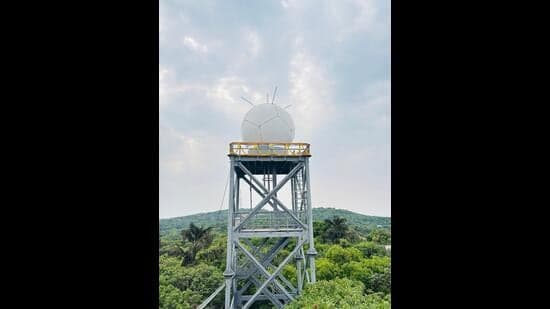
A state-of-the-art radar system was recently inaugurated in Mahabaleshwar, Western Ghats, situated approximately 1,400 meters above sea level. This advanced technology is designed to function as a real-time "weather eye in the sky," monitoring rainfall, cloud movements, and storm activity with enhanced precision.
The radar's strategic placement in Mahabaleshwar addresses the region's notoriously unpredictable weather, including sudden downpours, dense fog, and strong winds. Scientists anticipate that this system will significantly improve nowcasting capabilities, providing accurate short-term forecasts up to three hours for the Satara, Pune, and Konkan areas.
Beyond immediate forecasting, the radar is expected to be instrumental in studying complex meteorological phenomena such as orographic rainfall, thunderstorms, and cloud evolution over challenging terrains. This will bolster early warning systems for natural disasters like floods and landslides, while also benefiting aviation safety, disaster management, and water resource planning.
In a parallel development, the Indian Institute of Tropical Meteorology (IITM) formalized a partnership with the Indian Space Research Organisation (ISRO) through its Space Applications Centre (SAC). This memorandum of understanding aims to foster deeper collaboration in satellite meteorology. The joint effort will focus on integrating satellite and ground observations to develop sophisticated satellite-based weather products, refine air pollution monitoring, and improve atmospheric profiling.
This collaboration is poised to enhance forecasting accuracy and bolster India's overall preparedness for extreme weather events. Joint research initiatives will also target extreme weather phenomena, deep convection, lightning, and the impacts of climate change, including dedicated training programs and data sharing.
