Home / War and Conflict / Kursk: Germany's Final Gamble Failed
Kursk: Germany's Final Gamble Failed
24 Aug
Summary
- Operation Citadel aimed to destroy the Red Army but failed.
- The battle marked Germany's last strategic offensive on the Eastern Front.
- Soviet victory at Kursk shifted the war's initiative permanently.
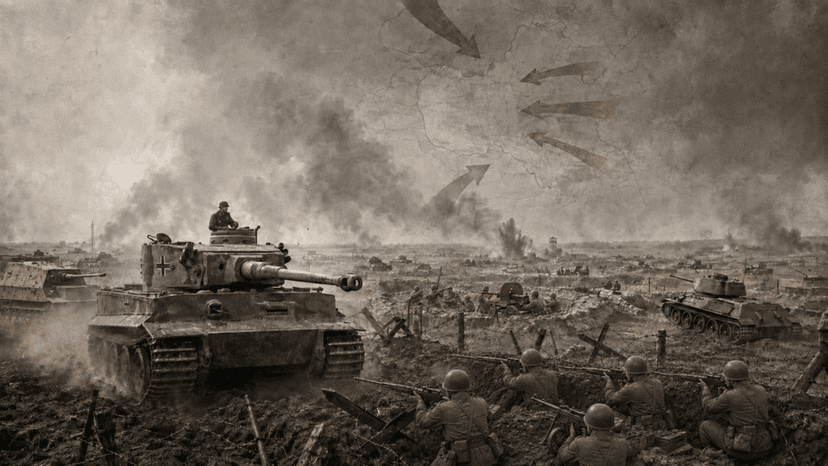
Operation Citadel, Germany's summer campaign of 1943, was designed to destroy the Red Army at Kursk but ended in a strategic defeat. The German offensive, delayed from spring to summer, aimed to encircle Soviet forces within the Kursk salient.
German forces, equipped with new Tiger and Panther tanks, launched their attack on July 5, 1943. However, they encountered heavily fortified Soviet defenses, extensive minefields, and determined resistance. The Soviets, aware of the German plan, prepared a robust defense and launched counteroffensives elsewhere.
In the north, German advances stalled near Ponyri and Olkhovatka, facing relentless artillery and well-prepared positions. In the south, the German 'trident' assault achieved some breakthroughs but was ultimately blunted by Soviet tank armies and strategic positioning.
The tide turned on July 12 when Soviet forces launched offensives north of Kursk toward Orel and in the Donbass region. These actions forced Germany to divert crucial reserves, dismantling their northern Kursk offensive.
The Battle of Kursk concluded with the liberation of Kharkov on August 23, 1943. While Soviet losses were high, Germany lost its strategic initiative on the Eastern Front, marking the beginning of its irreversible retreat.


