

Home / Technology / Physical AI Masters Complex Tasks with Adaptability
Physical AI Masters Complex Tasks with Adaptability
7 Apr
Summary
- New AI system masters physical skills previously needing human hands.
- Robots can now improvise and recover from unexpected disruptions.
- Achieves 99 percent success rates on delicate mechanical tasks.
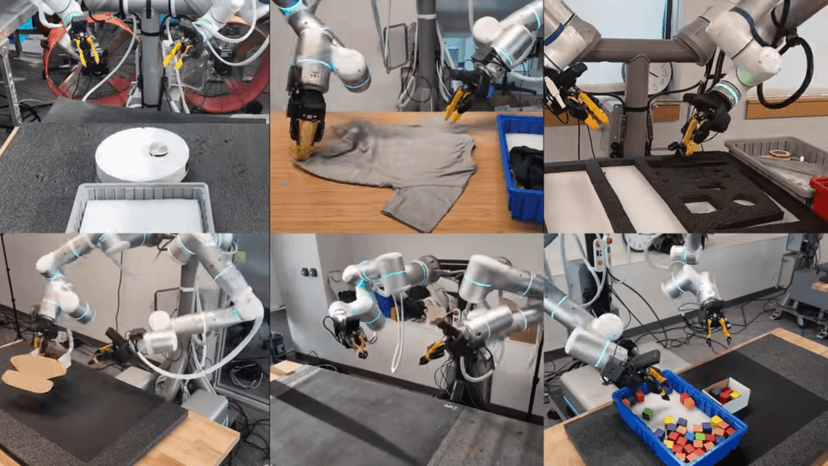
Robotic machine learning company Generalist has introduced GEN-1, a physical AI system demonstrating production-level success in tasks demanding human-level dexterity and muscle memory. This advanced model learns by processing petabytes of physical interaction data collected via 'data hands,' enabling it to perform precise actions like placing money into wallets and adaptable tasks such as folding laundry.
GEN-1 distinguishes itself by improvising and recovering from errors, even those outside its training parameters. Engineers describe scenarios where the robot shakes a bag to position a toy or intelligently readjusts grasped items, actions not explicitly programmed. This contrasts with older systems relying on pre-programmed motions or single-task focus.
This breakthrough follows Generalist's GEN-0 model and positions GEN-1 at a GPT-3-like inflection point. The company suggests the AI's performance now meets the criteria for deployment in economically viable settings, potentially paving the way for advanced domestic robots in the near future.
Other companies like Google and Physical Intelligence are also advancing physical AI. Tesla's Optimus robots, while demonstrated, are still not performing useful work, according to CEO Elon Musk.
