feedzop-word-mark-logo
searchLogin
Feedzop
homeFor YouUnited StatesUnited States
You
bookmarksYour BookmarkshashtagYour Topics
Trending
Terms of UsePrivacy PolicyAboutJobsPartner With Us

© 2026 Advergame Technologies Pvt. Ltd. ("ATPL"). Gamezop ® & Quizzop ® are registered trademarks of ATPL.

Gamezop is a plug-and-play gaming platform that any app or website can integrate to bring casual gaming for its users. Gamezop also operates Quizzop, a quizzing platform, that digital products can add as a trivia section.

Over 5,000 products from more than 70 countries have integrated Gamezop and Quizzop. These include Amazon, Samsung Internet, Snap, Tata Play, AccuWeather, Paytm, Gulf News, and Branch.

Games and trivia increase user engagement significantly within all kinds of apps and websites, besides opening a new stream of advertising revenue. Gamezop and Quizzop take 30 minutes to integrate and can be used for free: both by the products integrating them and end users

Increase ad revenue and engagement on your app / website with games, quizzes, astrology, and cricket content. Visit: business.gamezop.com

Property Code: 5571

Home / Science / Cosmic Puzzle Solved: Webb's Red Dots Were Disguised Black Holes

Cosmic Puzzle Solved: Webb's Red Dots Were Disguised Black Holes

18 Jan

•

Summary

  • Webb Telescope discovered 'little red dots' in the early universe.
  • New research suggests these dots are young black holes hidden by gas.
  • This explanation resolves a long-standing astronomical puzzle.

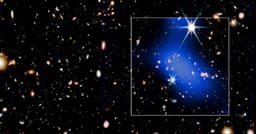
The James Webb Space Telescope has potentially solved a cosmic mystery surrounding enigmatic 'little red dots' first detected several years ago. These objects, observed when the universe was only several hundred million years old, defied initial explanations.

Scientists theorized they could be dense galaxies or supermassive black holes, but they lacked expected characteristics. New research published in Nature proposes that the 'little red dots' are indeed young black holes, actively consuming surrounding gas which creates a heat signature, giving them their distinct red color.

This groundbreaking explanation, stemming from over two years of study by researchers at the University of Copenhagen, suggests these black holes possess a near-perfect disguise, obscuring typical X-ray and radio emissions. The findings reconcile the 'little red dots' with established cosmological theories, explaining their appearance in the early universe and subsequent disappearance.


Disclaimer: This story has been auto-aggregated and auto-summarised by a computer program. This story has not been edited or created by the Feedzop team.
trending

Minnesota blizzard warning issued

trending

Winter storm warning issued

trending

Morant shines in London return

trending

Georgia counties winter storm warning

trending

Real Madrid wins La Liga

trending

Senegal Morocco AFCON Final

trending

Bills coach criticizes NFL ruling

trending

Rhamondre Stevenson eye injury

trending

Nico Collins injury update

The James Webb Space Telescope discovered numerous small, red objects in the early universe, which scientists nicknamed 'little red dots'.
Recent research suggests the 'little red dots' are young, supermassive black holes concealed within a cocoon of gas they are consuming.
The 'little red dots' perplexed astronomers because they appeared too massive and mature for early galaxies and lacked typical emissions from feeding black holes.

Read more news on

Scienceside-arrow

You may also like

Distant Signal: Echoes from Universe's Dawn Detected

12 Jan • 42 reads

article image

Billionaire's Bold Bet: Faster, Cheaper Astronomy

9 Jan • 55 reads

article image

Cosmic Twinkle: Pulsar Signals Decoded

7 Jan • 80 reads

article image

Johns Hopkins Provost Moves to Lead Caltech

6 Jan • 114 reads

article image

Alien Life: UK Scientist Predicts Discovery Within 50 Years

21 Dec, 2025 • 108 reads

article image