feedzop-word-mark-logo
searchLogin
Feedzop
homeFor YouUnited StatesUnited States
You
bookmarksYour BookmarkshashtagYour Topics
Trending
trending

Coca-Cola faces plastic criticism

trending

Texans upset Kansas City Chiefs

trending

LeBron James faces 76ers

trending

Caitlin Clark declined overseas offer

trending

Taylor Swift at Texans game?

trending

Guilford County schools early dismissal

trending

Golden Globes nominations unveiled December

trending

Walmart Lexington bomb threat

trending

IBM nears Confluent acquisition

Terms of UsePrivacy PolicyAboutJobsPartner With Us

© 2025 Advergame Technologies Pvt. Ltd. ("ATPL"). Gamezop ® & Quizzop ® are registered trademarks of ATPL.

Gamezop is a plug-and-play gaming platform that any app or website can integrate to bring casual gaming for its users. Gamezop also operates Quizzop, a quizzing platform, that digital products can add as a trivia section.

Over 5,000 products from more than 70 countries have integrated Gamezop and Quizzop. These include Amazon, Samsung Internet, Snap, Tata Play, AccuWeather, Paytm, Gulf News, and Branch.

Games and trivia increase user engagement significantly within all kinds of apps and websites, besides opening a new stream of advertising revenue. Gamezop and Quizzop take 30 minutes to integrate and can be used for free: both by the products integrating them and end users

Increase ad revenue and engagement on your app / website with games, quizzes, astrology, and cricket content. Visit: business.gamezop.com

Property Code: 5571

Home / Science / Voyager 1 Nears Light-Day Milestone

Voyager 1 Nears Light-Day Milestone

25 Nov

•

Summary

  • Voyager 1 will reach 16.1 billion miles in November 2026.
  • The spacecraft launched in 1977 and explored Jupiter and Saturn.
  • Voyager 1's power is diminishing, but it continues to transmit data.
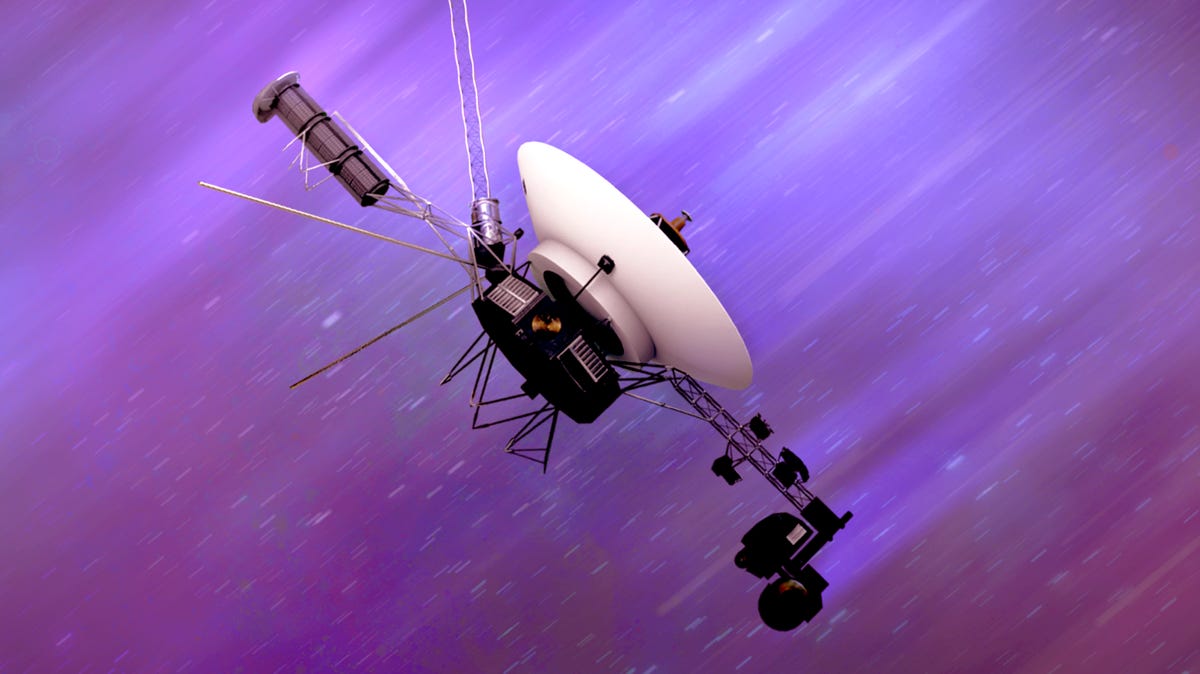
Voyager 1 Nears Light-Day Milestone

Voyager 1 is set to reach a significant distance milestone in November 2026, traveling 16.1 billion miles from Earth, a distance known as a light-day. Launched in 1977, the spacecraft has already provided invaluable data from its explorations of Jupiter and Saturn, discovering new moons and volcanic activity. It officially left our solar system in August 2012.

Currently within the sun's gravitational field but in interstellar space, Voyager 1 studies plasma waves and magnetic fields. Engineers recently resolved a computer glitch, demonstrating the ongoing efforts to maintain its functionality despite the immense distance and communication delays. The spacecraft's power, generated by radioisotope thermoelectric generators, is slowly decreasing.

To extend its mission, NASA is conserving power by shutting down non-essential systems. Voyager 1, along with its twin Voyager, carries the Golden Record, a message to potential extraterrestrial civilizations. Even as power fades, the spacecraft will continue its silent journey through the cosmos for billions of years.

Disclaimer: This story has been auto-aggregated and auto-summarised by a computer program. This story has not been edited or created by the Feedzop team.
Voyager 1 is projected to reach a light-day distance of 16.1 billion miles in November 2026.
Voyager 1 extensively photographed Jupiter in 1979 and Saturn in 1980.
Voyager 1 is powered by radioisotope thermoelectric generators, which are slowly decaying and reducing its power output.

Read more news on

Scienceside-arrowNASAside-arrow

You may also like

Hubble's Latest Glimpse: Comet 3I/ATLAS Approaches Earth

25 mins ago

article image

Uranus Radiation Mystery Solved by Voyager 2 Data

5 Dec • 9 reads

article image

Jared Isaacman: Can He Revitalize NASA's Space Program?

4 Dec • 30 reads

article image

Earth's Oceans Under Watch: New Satellite Measures Rising Seas

4 Dec • 18 reads

article image

SpaceX Launches Satellite to Tackle Global Sea Level Rise

17 Nov • 112 reads

article image