feedzop-word-mark-logo
searchLogin
Feedzop
homeFor YouUnited StatesUnited States
You
bookmarksYour BookmarkshashtagYour Topics
Trending
trending

Armed man at Temecula mall

trending

Taipei mass stabbing kills four

trending

Reddit CDN server errors

trending

Luke Air Force Base shooting

trending

Target app outage reported

trending

Baird upgrades Rivian stock

trending

Rhode Island energy outage

trending

Rocket Lab stock surges

trending

College football bowl games today

Terms of UsePrivacy PolicyAboutJobsPartner With Us

© 2025 Advergame Technologies Pvt. Ltd. ("ATPL"). Gamezop ® & Quizzop ® are registered trademarks of ATPL.

Gamezop is a plug-and-play gaming platform that any app or website can integrate to bring casual gaming for its users. Gamezop also operates Quizzop, a quizzing platform, that digital products can add as a trivia section.

Over 5,000 products from more than 70 countries have integrated Gamezop and Quizzop. These include Amazon, Samsung Internet, Snap, Tata Play, AccuWeather, Paytm, Gulf News, and Branch.

Games and trivia increase user engagement significantly within all kinds of apps and websites, besides opening a new stream of advertising revenue. Gamezop and Quizzop take 30 minutes to integrate and can be used for free: both by the products integrating them and end users

Increase ad revenue and engagement on your app / website with games, quizzes, astrology, and cricket content. Visit: business.gamezop.com

Property Code: 5571

Home / Science / Universe Expansion May Be Slowing, Not Accelerating

Universe Expansion May Be Slowing, Not Accelerating

21 Nov

•

Summary

  • New study suggests dark energy's force might be weakening over time.
  • Type 1a supernovae dimming could be due to progenitor star age.
  • Revised understanding could alter the universe's ultimate fate.
Universe Expansion May Be Slowing, Not Accelerating

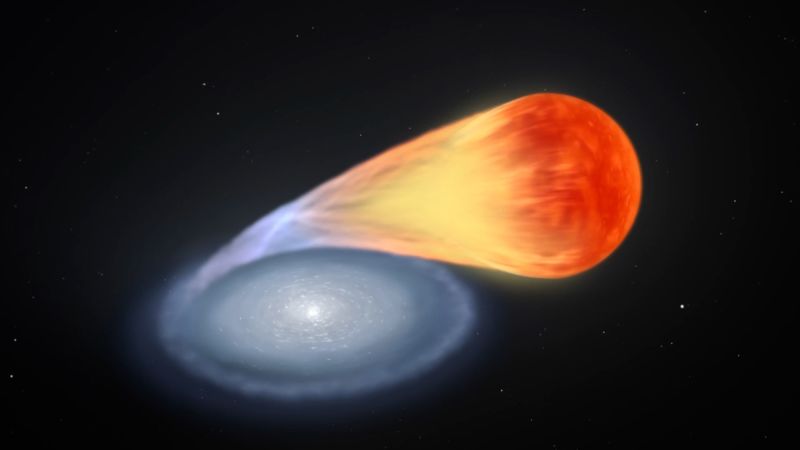
Recent astronomical research indicates that the universe's expansion may be decelerating, a finding that could dramatically reshape our understanding of cosmic evolution. This new perspective emerges from studies of Type 1a supernovae, previously considered reliable cosmic distance markers.

The current model, established in 1998, suggests dark energy drives an accelerating expansion. However, new analysis suggests that the dimming of distant supernovae might be influenced by the age of the stars that produced them, rather than solely by their increasing distance. This implies dark energy's influence might be waning.

If this revised understanding holds, the universe's ultimate fate could shift from continued expansion to a potential contraction, or Big Crunch. While met with skepticism from some scientists, the ongoing research, bolstered by upcoming observations from observatories like the Vera C. Rubin Observatory, promises to shed more light on this pivotal cosmological debate.

Disclaimer: This story has been auto-aggregated and auto-summarised by a computer program. This story has not been edited or created by the Feedzop team.
The 1998 discovery suggested that dark energy enables the universe to expand at an accelerating rate.
The new study proposes that the intrinsic brightness of Type 1a supernovae depends on progenitor star age, not just distance.
If the expansion slows significantly, the universe could eventually begin to contract, potentially leading to a Big Crunch.

Read more news on

Scienceside-arrow

You may also like

Exotic Exoplanet Orbits Dead Star, Stretches to Lemon Shape

8 hours ago • 3 reads

article image

Cosmic Crashes Spotted: Hubble Reveals Space Rock Collisions

1 day ago • 5 reads

article image

Hubble's Latest Glimpse: Comet 3I/ATLAS Approaches Earth

8 Dec • 75 reads

article image

Cosmic 'Rolling Pin' Spins Galaxies At Warp Speed

4 Dec • 101 reads

article image

70-Year-Old Photos Reveal UAP Near Nuclear Sites

4 Dec • 83 reads

article image