feedzop-word-mark-logo
searchLogin
Feedzop
homeFor YouUnited StatesUnited States
You
bookmarksYour BookmarkshashtagYour Topics
Trending
Terms of UsePrivacy PolicyAboutJobsPartner With Us

© 2026 Advergame Technologies Pvt. Ltd. ("ATPL"). Gamezop ® & Quizzop ® are registered trademarks of ATPL.

Gamezop is a plug-and-play gaming platform that any app or website can integrate to bring casual gaming for its users. Gamezop also operates Quizzop, a quizzing platform, that digital products can add as a trivia section.

Over 5,000 products from more than 70 countries have integrated Gamezop and Quizzop. These include Amazon, Samsung Internet, Snap, Tata Play, AccuWeather, Paytm, Gulf News, and Branch.

Games and trivia increase user engagement significantly within all kinds of apps and websites, besides opening a new stream of advertising revenue. Gamezop and Quizzop take 30 minutes to integrate and can be used for free: both by the products integrating them and end users

Increase ad revenue and engagement on your app / website with games, quizzes, astrology, and cricket content. Visit: business.gamezop.com

Property Code: 5571

Home / Science / NEVER-BEFORE-SEEN: Sun Erupts in Fiery Prominence Show

NEVER-BEFORE-SEEN: Sun Erupts in Fiery Prominence Show

23 Jan

•

Summary

  • A new mission uses an artificial eclipse to view the Sun's corona.
  • The Proba-3 mission captured towering prominences erupting into space.
  • These prominences are cooler plasma structures in the extremely hot corona.
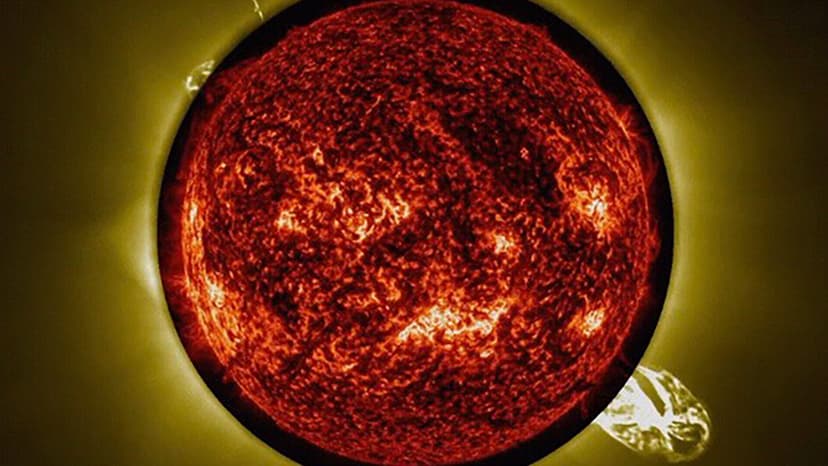
NEVER-BEFORE-SEEN: Sun Erupts in Fiery Prominence Show

Never-before-seen footage offers an extraordinary glimpse into the Sun's corona, the star's outer atmosphere. The European Space Agency's Proba-3 mission, launched in December 2024, utilizes a unique method involving two spacecraft to achieve this. One spacecraft acts as an "occulter," mimicking an artificial eclipse by blocking the Sun's bright center. The second spacecraft, a coronagraph, is positioned in the occulter's shadow to capture images of the faint corona.

This groundbreaking technique enabled the capture of a five-hour timelapse on September 2, 2025, revealing stunning details of the solar atmosphere. The footage highlights three massive eruptions of plasma, known as prominences, which extend outwards into space. These prominences, while still extremely hot at around 10,000 degrees Celsius, are significantly cooler than the surrounding corona, which can reach a million degrees Celsius.

trending

Climate change human displacement

trending

Intel stock crashes after outlook

trending

Uncle Floyd Vivino dies

trending

Pennsylvania winter storm causes closings

trending

NYC braces for major snow

trending

India vs New Zealand T20I

trending

Savannah Guthrie vocal cord surgery

trending

Texas new home sales rebound

trending

Giant pandas to Munich zoo

The Proba-3 mission's success in capturing these dynamic events so clearly and in rapid succession is a significant achievement for solar observation. The detailed views provided by this mission offer valuable insights into the Sun's complex and energetic phenomena.

Disclaimer: This story has been auto-aggregated and auto-summarised by a computer program. This story has not been edited or created by the Feedzop team.
The Proba-3 mission uses a spacecraft to block the Sun's bright center, creating an artificial eclipse to view the fainter corona.
Prominences are large eruptions of plasma from the Sun's surface, extending into its corona.
Proba-3 uses an occulter spacecraft to block the Sun and a coronagraph spacecraft to photograph the corona in its shadow.

Read more news on

Scienceside-arrow

You may also like

Argentina's Atenea Microsatellite Joins NASA Artemis II Mission

17 Jan • 45 reads

article image

ISRO's New Eye: Anvesha Boosts India's Space Surveillance

12 Jan • 55 reads

article image

ESA Server Hack: 200GB Data Stolen!

3 Jan • 84 reads

article image

Cosmic Mystery: Interstellar Object Triggers Global Defense

6 Dec, 2025 • 259 reads

article image

Interstellar Object's 'Heartbeat' Glows Brighter Near Earth

4 Dec, 2025 • 288 reads

article image