feedzop-word-mark-logo
searchLogin
Feedzop
homeFor YouUnited StatesUnited States
You
bookmarksYour BookmarkshashtagYour Topics
Trending
trending

Powerball jackpot nears one billion

trending

John Stamos joins Hunting Wives

trending

Taylor Swift Eras Tour docuseries

trending

Wendy Williams guardianship could end

trending

Stephen King saved HBO show

trending

Massachusetts blocks sports prediction market

trending

Detroit schools closed due winter

trending

South Korea: Label AI ads

trending

Conduent data breach millions hit

Terms of UsePrivacy PolicyAboutJobsPartner With Us

© 2025 Advergame Technologies Pvt. Ltd. ("ATPL"). Gamezop ® & Quizzop ® are registered trademarks of ATPL.

Gamezop is a plug-and-play gaming platform that any app or website can integrate to bring casual gaming for its users. Gamezop also operates Quizzop, a quizzing platform, that digital products can add as a trivia section.

Over 5,000 products from more than 70 countries have integrated Gamezop and Quizzop. These include Amazon, Samsung Internet, Snap, Tata Play, AccuWeather, Paytm, Gulf News, and Branch.

Games and trivia increase user engagement significantly within all kinds of apps and websites, besides opening a new stream of advertising revenue. Gamezop and Quizzop take 30 minutes to integrate and can be used for free: both by the products integrating them and end users

Increase ad revenue and engagement on your app / website with games, quizzes, astrology, and cricket content. Visit: business.gamezop.com

Property Code: 5571

Home / Science / Space Dust: Cosmic Catalyst for Life's Building Blocks

Space Dust: Cosmic Catalyst for Life's Building Blocks

24 Nov

•

Summary

  • Space dust acts as a catalyst, facilitating complex molecule formation.
  • Reactions between common space molecules form life precursors on dust.
  • Dust chemistry is essential for creating molecular building blocks in space.
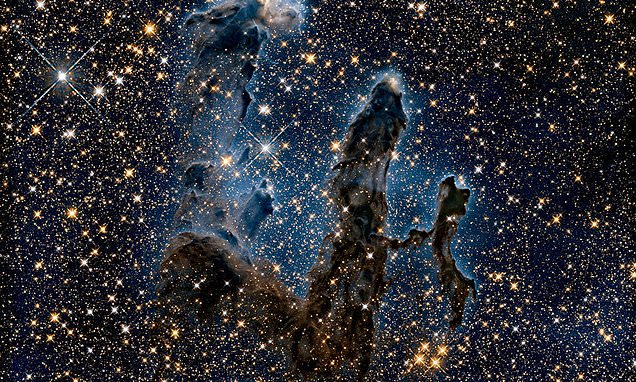
Space Dust: Cosmic Catalyst for Life's Building Blocks

New research indicates that particles of space dust are vital for generating the foundational molecules required for life. Scientists from Heriot-Watt University, in collaboration with teams in Germany and the US, have demonstrated that mineral dust acts as a catalyst.

This catalytic effect allows simple molecules, such as carbon dioxide and ammonia prevalent in space, to transform into more complex, potentially life-forming compounds. Their study, published in The Astrophysical Journal, found these surface reactions efficiently produce ammonium carbamate, a key chemical precursor to molecules essential for life, but only when dust is present.

The findings suggest that dust grains are far more active in astrochemistry than previously understood. These particles may provide the necessary micro-environments within interstellar clouds and protoplanetary disks for molecules to meet and evolve, overcoming space's harsh conditions to initiate the chemistry that could lead to life.


Disclaimer: This story has been auto-aggregated and auto-summarised by a computer program. This story has not been edited or created by the Feedzop team.
Space dust acts as a catalyst, providing surfaces for common molecules like carbon dioxide and ammonia to react and form more complex, life-essential compounds.
The study found that mineral dust is crucial for efficient surface reactions that create precursors to life's molecules, even in extreme cold and vacuum.
While not directly creating life, dust chemistry is a prerequisite for making the molecular building blocks that could eventually lead to life.

Read more news on

Scienceside-arrow

You may also like

LIGO's Laser Precision Unlocks Deeper Universe

4 Dec • 38 reads

article image

70-Year-Old Photos Reveal UAP Near Nuclear Sites

4 Dec • 45 reads

article image

Lost Science: Top Lab's Work in Jeopardy

4 Dec • 39 reads

article image

AI Decodes 3.3 Billion-Year-Old Molecular 'Ghosts' to Reveal Earliest Signs of Life

18 Nov • 178 reads

article image

Pleiades Star Cluster Harbors Over 3,000 'Lost Sisters', Astronomers Reveal

12 Nov • 130 reads

article image