feedzop-word-mark-logo
searchLogin
Feedzop
homeFor YouUnited StatesUnited States
You
bookmarksYour BookmarkshashtagYour Topics
Trending
trending

School teens' swastika photo outrage

trending

Texans extend winning streak

trending

Falcons beat woeful Cardinals

trending

Panthers beat Buccaneers, lead NFC

trending

Crosby passes Lemieux: Penguins points

trending

Titans defeat Chiefs

trending

Texans dominate struggling Raiders

trending

Kentucky defeats Texas A&M

trending

Red Sox acquire Willson Contreras

Terms of UsePrivacy PolicyAboutJobsPartner With Us

© 2025 Advergame Technologies Pvt. Ltd. ("ATPL"). Gamezop ® & Quizzop ® are registered trademarks of ATPL.

Gamezop is a plug-and-play gaming platform that any app or website can integrate to bring casual gaming for its users. Gamezop also operates Quizzop, a quizzing platform, that digital products can add as a trivia section.

Over 5,000 products from more than 70 countries have integrated Gamezop and Quizzop. These include Amazon, Samsung Internet, Snap, Tata Play, AccuWeather, Paytm, Gulf News, and Branch.

Games and trivia increase user engagement significantly within all kinds of apps and websites, besides opening a new stream of advertising revenue. Gamezop and Quizzop take 30 minutes to integrate and can be used for free: both by the products integrating them and end users

Increase ad revenue and engagement on your app / website with games, quizzes, astrology, and cricket content. Visit: business.gamezop.com

Property Code: 5571

Home / Science / Space Data Centers: O-RAID Secures Orbital Data

Space Data Centers: O-RAID Secures Orbital Data

16 Dec

•

Summary

  • Satellites can now act as distributed storage, creating a 'constellation-level RAID'.
  • O-RAID architecture ensures data survival even if individual satellites fail.
  • Lunar data centers could orbit the Moon, avoiding risky surface landings.

Space Data Centers: O-RAID Secures Orbital Data

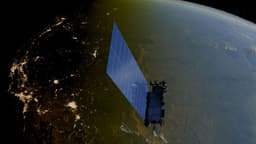
Low Earth orbit is rapidly expanding with a new focus on space data centers, moving beyond simple communication relays. Initiatives are now deploying significant processing power in orbit, leading to a critical need for robust data resilience. Traditional methods like RAID are impossible on single satellites due to physical limitations.

A new "Orbital Redundant Array of Independent Devices" (O-RAID) architecture proposes treating entire satellite constellations as storage mediums. By distributing data fragments and parity across neighboring satellites via inter-satellite links, O-RAID ensures data can be mathematically reconstructed on the fly, even if individual satellites fail.

This resilience is vital for the burgeoning lunar economy, suggesting Geostationary Moon Orbit data centers. These orbital facilities would service lunar assets without the extreme risks and costs of landing sensitive server equipment, representing a significant leap in space infrastructure.


Disclaimer: This story has been auto-aggregated and auto-summarised by a computer program. This story has not been edited or created by the Feedzop team.
O-RAID is a constellation-level RAID architecture that stripes data across multiple satellites via inter-satellite links, allowing for data reconstruction even if individual satellites fail.
Single satellites are too limited by mass, power, and volume to house the physical redundancy required for internal RAID.
Data centers can be placed in stable orbits around the Moon, creating a high-bandwidth 'orbital cloud' to service surface assets.

Read more news on

Scienceside-arrow

You may also like

SpaceX Satellite Explodes, Debris Floats in Orbit

1 day ago • 5 reads

article image

Space Crowded: Starlink Near Miss Sparks Collision Fears

16 Dec • 33 reads

article image

Apolink Taps GomSpace for LEO Relay Satellite

15 Dec • 37 reads

article image

Satcom Ground Segment Booms to $106B

12 Dec • 31 reads

article image

Canoo Vans Idle: NASA & USPS Halt Use of Bankrupt EV

9 Dec • 63 reads

article image