Home / Science / Lost Moon's Crash Reshaped Saturn and Its Rings
Lost Moon's Crash Reshaped Saturn and Its Rings
23 Feb
Summary
- Titan may have formed from a collision with an ancient, larger moon.
- This event could explain Saturn's tilt and the formation of its rings.
- New research combines data, theories, and simulations for Titan's origin.
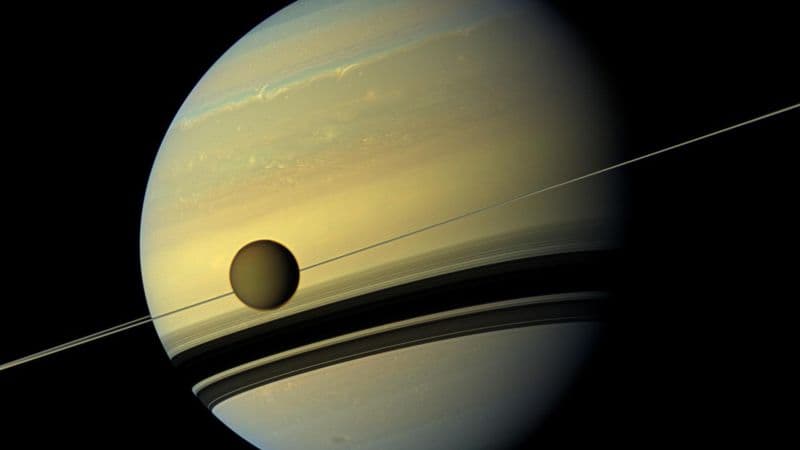
Researchers have proposed a novel theory for the origin of Saturn's largest moon, Titan. Combining data from the Cassini mission, existing theories, and computer simulations, the study suggests that Titan formed about half a billion years ago after colliding with an even larger, now-lost moon.
This significant impact event is believed to have profoundly reshaped the Saturnian system. It may have caused Saturn's current tilt, which is 26.7 degrees relative to its orbital plane, and could also be responsible for the formation of Saturn's rings.
The collision hypothesis also offers explanations for other celestial bodies and phenomena. It could account for the existence of Hyperion, Saturn's largest irregular moon, potentially as a fragment from the impact. Furthermore, Titan's observed rapid drift away from Saturn is consistent with the aftermath of such a massive collision.
Scientists previously attributed Saturn's tilt to gravitational disturbances from Neptune. However, Cassini data indicated inconsistencies, leading to theories like the lost moon Chrysalis. This new research refines that idea, proposing a collision between proto-Titan and proto-Hyperion.
Saturn's rings might have formed even later, hundreds of millions of years after the initial collision, possibly due to Titan's expanding orbit perturbing inner moons into further collisions. NASA's upcoming Dragonfly mission, scheduled for a 2028 launch and 2034 arrival, will investigate Titan's surface and composition, potentially providing crucial evidence for this theory.
Experts not involved in the study acknowledge its compelling nature. They note that the theory offers a plausible, albeit complex, sequence of events that aligns with current observations of the Saturnian system's dynamic evolution. The Cassini mission's legacy includes revealing Titan's faster-than-expected orbital expansion, a key factor in understanding Saturn's system.