Home / Science / Cosmic Volcano Reborn: Black Hole Erupts After 100M Years
Cosmic Volcano Reborn: Black Hole Erupts After 100M Years
16 Jan
Summary
- Supermassive black hole J1007+3540 erupted after 100 million years of silence.
- Erupting jets are nearly 10 times wider than the Milky Way galaxy.
- Past eruptions shaped the black hole's current violent outburst.
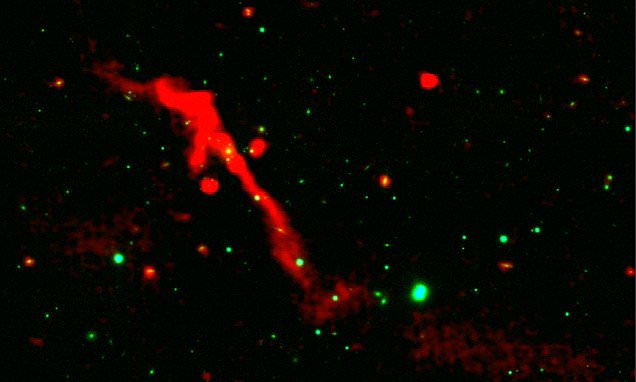
Astronomers have captured a spectacular event: the 'reawakening' of a supermassive black hole after a 100-million-year slumber. This cosmic volcano, known as J1007+3540, is now spewing superheated plasma jets with enough force to reshape its host galaxy. These eruptions, nearly ten times the width of our own Milky Way, reveal the violent, chaotic struggle at the galaxy's core.
The black hole's activity stems from it feeding on surrounding gas, causing matter to swirl inwards and heat to extreme temperatures. This process results in powerful jets of plasma ejected into space, a phenomenon that has occurred episodically over cosmic timescales. Researchers observed faded plasma from previous eruptions, indicating a long history of violent activity shaped by the extreme environment of its galaxy cluster.
While the supermassive black hole at the center of our own Milky Way, Sagittarius A*, is currently dormant, scientists believe it could also erupt in the future. Such an event could reshape the universe and potentially pose a threat to life on Earth, though it is not expected for billions of years.