feedzop-word-mark-logo
searchLogin
Feedzop
homeFor YouUnited StatesUnited States
You
bookmarksYour BookmarkshashtagYour Topics
Trending
Terms of UsePrivacy PolicyAboutJobsPartner With Us

© 2026 Advergame Technologies Pvt. Ltd. ("ATPL"). Gamezop ® & Quizzop ® are registered trademarks of ATPL.

Gamezop is a plug-and-play gaming platform that any app or website can integrate to bring casual gaming for its users. Gamezop also operates Quizzop, a quizzing platform, that digital products can add as a trivia section.

Over 5,000 products from more than 70 countries have integrated Gamezop and Quizzop. These include Amazon, Samsung Internet, Snap, Tata Play, AccuWeather, Paytm, Gulf News, and Branch.

Games and trivia increase user engagement significantly within all kinds of apps and websites, besides opening a new stream of advertising revenue. Gamezop and Quizzop take 30 minutes to integrate and can be used for free: both by the products integrating them and end users

Increase ad revenue and engagement on your app / website with games, quizzes, astrology, and cricket content. Visit: business.gamezop.com

Property Code: 5571

Home / Science / Six Planets Align: Rare Celestial Parade This Month!

Six Planets Align: Rare Celestial Parade This Month!

21 Jan

•

Summary

  • Six planets will be visible together for two weeks.
  • The event is best viewed around 6:45 p.m. local time.
  • A telescope is highly recommended for optimal viewing.
Six Planets Align: Rare Celestial Parade This Month!

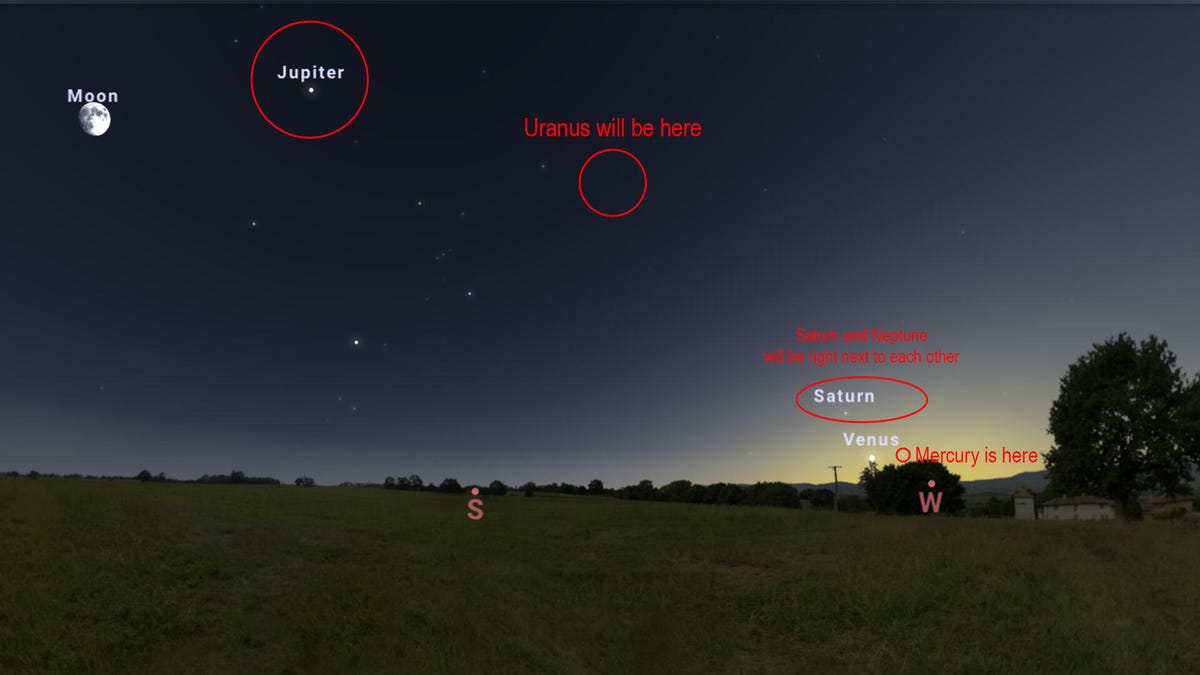
A remarkable celestial event, known as a planet parade, is set to occur in the coming weeks, offering a rare opportunity to see six planets simultaneously. From February 21st to February 28th, Mercury, Venus, Jupiter, Saturn, Uranus, and Neptune will be visible in the night sky. This phenomenon is especially challenging for viewers due to its proximity to sunset, with the best viewing window around 6:45 p.m. local time.

Four of the planets—Mercury, Venus, Saturn, and Neptune—will be clustered near the western horizon. Jupiter and Uranus will remain visible for longer, following similar paths across the sky. While the parade is globally visible, a telescope is highly recommended, particularly for spotting Uranus and Neptune, and for enhancing the view of the other planets against the twilight.

This February event marks the first of three planet parades anticipated in 2026. Skywatchers are advised to use sky map applications to locate the planets and to find a location with minimal light pollution for the best possible experience.

trending

Severe geomagnetic storm alert

trending

Jerusalem daycare babies dead

trending

Mets acquire Luis Robert Jr.

trending

Apple TV service disruption

trending

Punta Cana tourism surge

trending

Warriors, Raptors starting lineups change

trending

Carlos Beltran Hall of Fame

trending

Miami Ohio basketball improves to 20-0

trending

Mike McDaniel joins Chargers

Disclaimer: This story has been auto-aggregated and auto-summarised by a computer program. This story has not been edited or created by the Feedzop team.
The next planet parade, featuring six planets, is visible from February 21 to February 28, 2026.
Venus, Jupiter, Saturn, Mercury, Uranus, and Neptune will be visible during the February 2026 planet parade.
While some planets can be seen with the naked eye, a telescope is highly recommended for optimal viewing, especially for Uranus and Neptune.

Read more news on

Scienceside-arrow

You may also like

Jupiter Dazzles: Planet's Opposition Shines Bright!

10 Jan • 68 reads

article image

Europa's Ocean: Life's Spark Dimmed by New Study

9 Jan • 60 reads

article image

2026: Moon Missions & Solar Spectacles Beckon!

30 Dec, 2025 • 126 reads

article image

Titan's Ocean Mystery: Ice and Slush Instead?

17 Dec, 2025 • 160 reads

article image

Europa's 'Wall Demon' Hints at Hidden Ocean Life

16 Dec, 2025 • 208 reads

article image