feedzop-word-mark-logo
searchLogin
Feedzop
homeFor YouUnited StatesUnited States
You
bookmarksYour BookmarkshashtagYour Topics
Trending
Terms of UsePrivacy PolicyAboutJobsPartner With Us

© 2026 Advergame Technologies Pvt. Ltd. ("ATPL"). Gamezop ® & Quizzop ® are registered trademarks of ATPL.

Gamezop is a plug-and-play gaming platform that any app or website can integrate to bring casual gaming for its users. Gamezop also operates Quizzop, a quizzing platform, that digital products can add as a trivia section.

Over 5,000 products from more than 70 countries have integrated Gamezop and Quizzop. These include Amazon, Samsung Internet, Snap, Tata Play, AccuWeather, Paytm, Gulf News, and Branch.

Games and trivia increase user engagement significantly within all kinds of apps and websites, besides opening a new stream of advertising revenue. Gamezop and Quizzop take 30 minutes to integrate and can be used for free: both by the products integrating them and end users

Increase ad revenue and engagement on your app / website with games, quizzes, astrology, and cricket content. Visit: business.gamezop.com

Property Code: 5571

Home / Science / Distant Signal: Echoes from Universe's Dawn Detected

Distant Signal: Echoes from Universe's Dawn Detected

12 Jan

•

Summary

  • Signal detected from 13 billion light-years, originating from early universe.
  • GRB 250314A, an ancient supernova, matches nearby stellar explosions.
  • JWST confirmed the event, revealing early stars might be similar to modern ones.
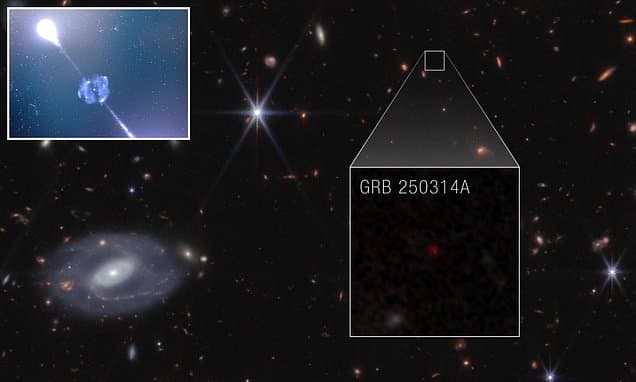
Distant Signal: Echoes from Universe's Dawn Detected

Scientists have detected a brief, 10-second signal from an astonishing 13 billion light-years away. This high-energy gamma-ray burst, named GRB 250314A, originated from the universe's early stages, approximately 730 million years after the Big Bang. The signal was first captured on March 14, 2025, by the joint France-China SVOM satellite, designed to detect such cosmic events.

The James Webb Space Telescope later confirmed the discovery in the summer of 2025, analyzing the fading glow of the ancient supernova. Researchers are particularly intrigued because this explosion from the dawn of time exhibits characteristics strikingly similar to supernovae observed in the nearby, modern universe. This challenges prior scientific assumptions about early stars being significantly larger, hotter, and more volatile.

trending

Pittman accused in synagogue fire

trending

Anthropic releases Claude Cowork feature

trending

Al Hilal beats Al Nassr

trending

Betterment crypto scam message

trending

Google stock: Strong performance in 2025

trending

FA Cup fourth-round draw

trending

Transfer portal rankings for Texas

trending

Tottenham close to Gallagher deal

trending

Koepka returns to PGA Tour

This rare detection, one of only a handful from the universe's first billion years, suggests that early stars may have behaved more like those we see today. The findings from detailed Webb Telescope observations, published in December 2025, indicate that this ancient supernova possessed the same brightness and radiation signature as later stellar explosions. This discovery opens new avenues for understanding the universe's formative period.

Disclaimer: This story has been auto-aggregated and auto-summarised by a computer program. This story has not been edited or created by the Feedzop team.
GRB 250314A is a gamma-ray burst believed to be the earliest recorded supernova, detected from 13 billion light-years away.
The signal was first detected by the SVOM satellite, with confirmation from NASA's James Webb Space Telescope.
It looks remarkably similar to supernovae observed in the modern universe, contrary to expectations about early stars.

Read more news on

Scienceside-arrow

You may also like

Tiny Probe Aids Webb's Hunt for Alien Worlds

3 hours ago • 4 reads

article image

Cosmic Enigma: 'Cloud-9' Could Reveal Dark Matter's Nature

9 Jan • 49 reads

article image

Cosmic Twinkle: Pulsar Signals Decoded

7 Jan • 51 reads

article image

Hubble Spots Cosmic Star Nursery

1 Jan • 80 reads

article image

Exotic Exoplanet Orbits Dead Star, Stretches to Lemon Shape

19 Dec, 2025 • 126 reads

article image