Home / Science / Distant Signal: Echoes from Universe's Dawn Detected
Distant Signal: Echoes from Universe's Dawn Detected
12 Jan
Summary
- Signal detected from 13 billion light-years, originating from early universe.
- GRB 250314A, an ancient supernova, matches nearby stellar explosions.
- JWST confirmed the event, revealing early stars might be similar to modern ones.
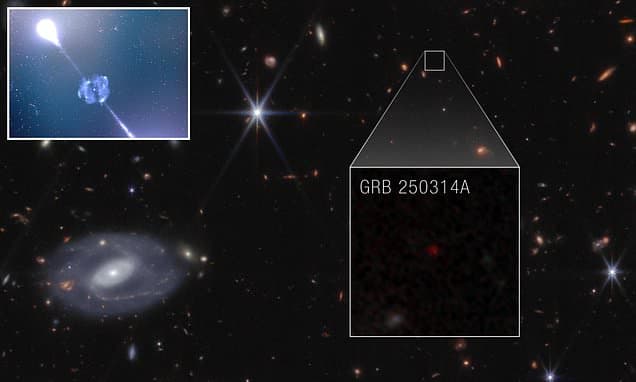
Scientists have detected a brief, 10-second signal from an astonishing 13 billion light-years away. This high-energy gamma-ray burst, named GRB 250314A, originated from the universe's early stages, approximately 730 million years after the Big Bang. The signal was first captured on March 14, 2025, by the joint France-China SVOM satellite, designed to detect such cosmic events.
The James Webb Space Telescope later confirmed the discovery in the summer of 2025, analyzing the fading glow of the ancient supernova. Researchers are particularly intrigued because this explosion from the dawn of time exhibits characteristics strikingly similar to supernovae observed in the nearby, modern universe. This challenges prior scientific assumptions about early stars being significantly larger, hotter, and more volatile.
This rare detection, one of only a handful from the universe's first billion years, suggests that early stars may have behaved more like those we see today. The findings from detailed Webb Telescope observations, published in December 2025, indicate that this ancient supernova possessed the same brightness and radiation signature as later stellar explosions. This discovery opens new avenues for understanding the universe's formative period.


