

Home / Science / NASA: Mars Microbial Life 90% Likely!
NASA: Mars Microbial Life 90% Likely!
1 Apr
Summary
- Administrator Isaacman states a 90% chance of microbial life on Mars.
- Artemis II mission marks NASA's return to the moon after 50 years.
- Perseverance rover samples show potential signs of past Martian life.
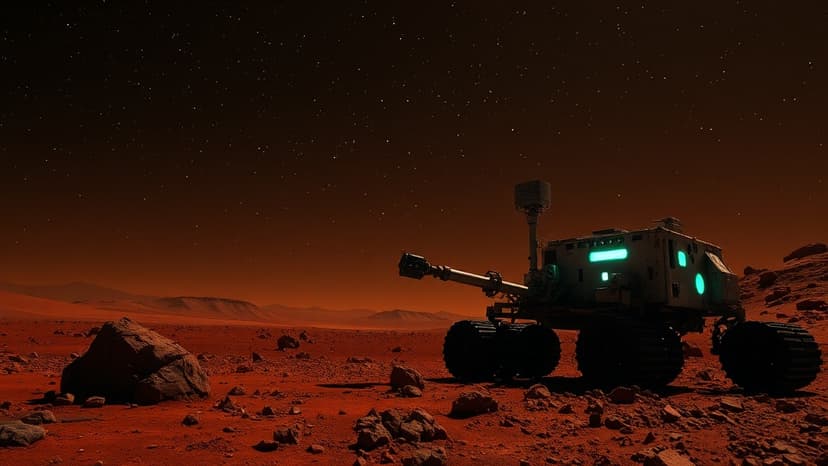
NASA Administrator Jared Isaacman expressed a strong conviction, stating there is a 90% probability of discovering microbial life on Mars if samples can be returned. He highlighted the immense scale of the universe, suggesting life beyond Earth is highly probable, though not necessarily in forms depicted in popular culture. This perspective emerges as NASA embarks on the Artemis II mission, scheduled for launch today. This 10-day lunar flyby is a significant milestone, representing humanity's return to the moon after a half-century hiatus.
The Artemis II crew, including NASA astronauts Reid Wiseman, Victor Glover, Christina Koch, and Canadian Space Agency astronaut Jeremy Hansen, will journey further and faster around the moon than ever before. The mission will test the Orion capsule and the Space Launch System rocket, with its 8.8 million pounds of thrust. The crew will perform a translunar injection burn, orbit the moon, and then splash down in the Pacific Ocean, gathering crucial data for subsequent missions like Artemis III in 2027 and Artemis IV in 2028, which aims to land astronauts on the lunar surface.
Administrator Isaacman also noted recent scientific discussions regarding potential microbial life on Mars. He referenced findings from the Perseverance rover, where samples collected from ancient Martian rocks have exhibited unusual seed-like shapes and spots. Scientists, including Nicky Fox and Joel Hurowitz, are examining these features, nicknamed 'poppy seeds' and 'leopard spots,' found in mud-like rocks within the Jezero crater. While these signatures are considered the 'clearest sign of life' detected so far, further data collection and confirmation by the scientific community are pending before definitively concluding the existence of past Martian life.

