

Home / Science / Moon Landing's Legacy: Science, Scrutiny & Space
Moon Landing's Legacy: Science, Scrutiny & Space
2 Apr
Summary
- NASA's Artemis II mission reignites interest in the 1969 moon landing.
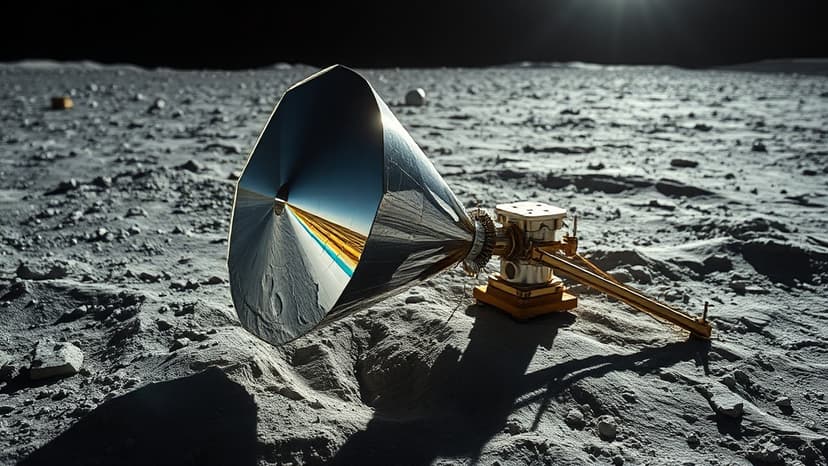
- Artifacts like the Lunar Laser Ranging Retroreflector remain scientifically active.
- Public debate over mission imagery and authenticity persists today.
The upcoming Artemis II mission is drawing renewed attention to the historic 1969 moon landing. NASA's preparations are prompting a re-evaluation of archival images and broadcasts from the Apollo 11 mission, fueling public nostalgia and ongoing debates. The original mission crew, Neil Armstrong, Buzz Aldrin, and Michael Collins, achieved a monumental feat, planting an American flag and delivering a memorable quote.
Scientific engagement with the Apollo era continues, with the Lunar Laser Ranging Retroreflector, installed during the mission, still in active use for experiments. Despite its scientific utility, persistent public curiosity and skepticism regarding the mission's imagery and presentation remain subjects of discussion.
Three potential future scenarios are emerging: a best-case scenario where renewed attention leads to clarified archival context and recognition of the mission's scientific significance; a most likely scenario where nostalgia for images and broadcasts continues alongside persistent, unresolved debates; and a most challenging scenario where conspiracy theories intensify, overshadowing scientific discussions.
This renewed focus presents opportunities for NASA and the scientific community to gain support for ongoing experiments and artifact preservation. Conversely, public discourse risks being degraded if controversies overshadow the mission's scientific legacy, potentially oversimplifying a complex technical achievement through visual media alone.
