Home / Science / Milky Way's Heart Mapped in Stunning Detail
Milky Way's Heart Mapped in Stunning Detail
6 Mar
Summary
- Most complete, high-resolution map of cold gas at Milky Way's center created.
- ALMA telescope in Chile captured detailed images over four years.
- Map aids understanding of star and planet formation, including our solar system.
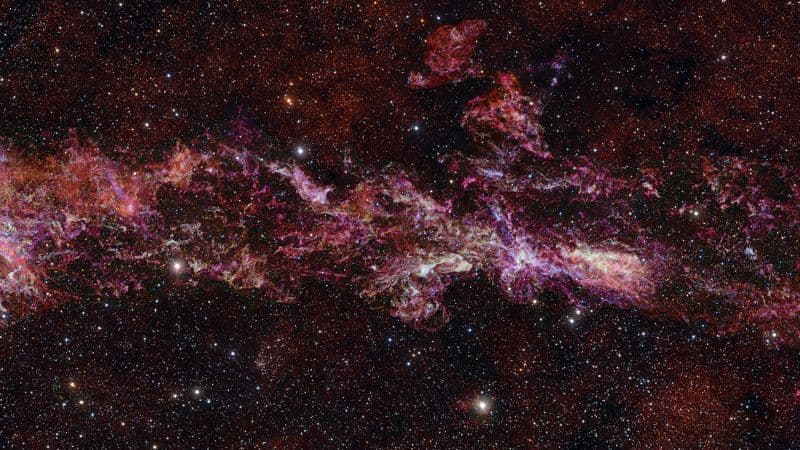
An international team has produced the most comprehensive, high-resolution map of the cold gas residing at the heart of the Milky Way. This crucial raw material is the fundamental component from which stars and planets eventually form. The groundbreaking imagery was captured using the Atacama Large Millimeter/submillimeter Array (ALMA), a sophisticated telescope located in the Chilean Andes.
The four-year ACES survey utilized ALMA's powerful capabilities to map the molecular gas in the galaxy's dense and turbulent Central Molecular Zone. This region, shaped by the immense gravitational pull of the supermassive black hole Sagittarius A*, closely mirrors conditions in the early universe when our solar system began to form approximately 4.5 billion years ago.
Previous astronomical observations offered fragmented views, but the ACES map provides an unprecedented, holistic perspective of the gas distribution in three-dimensional space. By analyzing the frequencies of light emitted by different molecules, scientists can determine gas velocities and chemical compositions, revealing clues about star formation processes in this extreme environment.
This extensive collaboration involved approximately 160 scientists and engineers from around the globe, highlighting the massive international effort required for such large-scale astronomical endeavors. The insights gained from this detailed map are expected to deepen our understanding of cosmic origins and the processes that led to the formation of our own planetary system.