feedzop-word-mark-logo
searchLogin
Feedzop
homeFor YouUnited StatesUnited States
You
bookmarksYour BookmarkshashtagYour Topics
Trending
trending

Universal flu vaccine challenge

trending

Man City vs Brentford LIVE

trending

Mammoth vs. Red Wings game

trending

Micron stock soars on AI

trending

Phillies land Brad Keller

trending

Atletico Baleares vs Atletico Madrid

trending

Cavaliers vs. Bulls watch

trending

Dolphins to release Matthew Judon

trending

Celtic faces Dundee United

Terms of UsePrivacy PolicyAboutJobsPartner With Us

© 2025 Advergame Technologies Pvt. Ltd. ("ATPL"). Gamezop ® & Quizzop ® are registered trademarks of ATPL.

Gamezop is a plug-and-play gaming platform that any app or website can integrate to bring casual gaming for its users. Gamezop also operates Quizzop, a quizzing platform, that digital products can add as a trivia section.

Over 5,000 products from more than 70 countries have integrated Gamezop and Quizzop. These include Amazon, Samsung Internet, Snap, Tata Play, AccuWeather, Paytm, Gulf News, and Branch.

Games and trivia increase user engagement significantly within all kinds of apps and websites, besides opening a new stream of advertising revenue. Gamezop and Quizzop take 30 minutes to integrate and can be used for free: both by the products integrating them and end users

Increase ad revenue and engagement on your app / website with games, quizzes, astrology, and cricket content. Visit: business.gamezop.com

Property Code: 5571

Home / Science / Cosmic Crashes Spotted: Hubble Reveals Space Rock Collisions

Cosmic Crashes Spotted: Hubble Reveals Space Rock Collisions

19 Dec

•

Summary

  • Hubble telescope observed aftermath of two large cosmic collisions.
  • Massive space rocks, estimated over 37 miles wide, smashed together.
  • These rare events occur near Fomalhaut approximately once every 100,000 years.
Cosmic Crashes Spotted: Hubble Reveals Space Rock Collisions

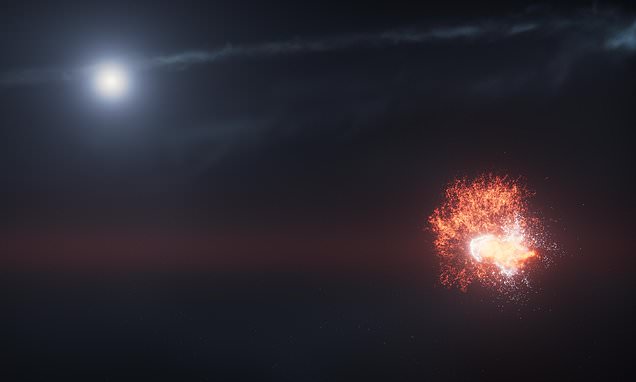
The Hubble Space Telescope has provided a rare look at the dramatic aftermath of two cosmic collisions, helping scientists resolve a decades-old astronomical puzzle. Initially, a bright spot near the young star Fomalhaut was thought to be a planet, but observations in 2023 revealed its disappearance and the emergence of a new celestial feature.

This phenomenon was identified as the dusty debris from two massive space rock impacts. These rocks, estimated to be at least 37 miles wide, collided to form dense dust clouds. Researchers believe such cataclysmic events near Fomalhaut happen infrequently, perhaps only once every 100,000 years.

The study, published in the journal Science, highlights the value of these observations for understanding planet formation, akin to viewing an early snapshot of our solar system. Scientists will continue to monitor the evolving dust cloud to better comprehend these violent cosmic processes.

Disclaimer: This story has been auto-aggregated and auto-summarised by a computer program. This story has not been edited or created by the Feedzop team.
The Hubble telescope observed the aftermath of two rare cosmic collisions involving massive space rocks.
Scientists estimate the space rocks involved in the collisions were at least 37 miles wide.
Theories suggest these types of massive collisions occur in the same vicinity about once every 100,000 years.

Read more news on

Scienceside-arrow

You may also like

Interstellar Comet Nears Earth!

16 Dec • 25 reads

article image

NASA Astrophysics: Bright Future Ahead Despite Budget Woes

12 Dec • 48 reads

article image

Hubble's Latest Glimpse: Comet 3I/ATLAS Approaches Earth

8 Dec • 71 reads

article image

Jared Isaacman: Can He Revitalize NASA's Space Program?

4 Dec • 89 reads

article image

Satellites to Obscure Hubble Telescope Views

3 Dec • 88 reads

article image