Home / Science / 1,600-Year-Old Tunnels Found Under Istanbul Landmark
1,600-Year-Old Tunnels Found Under Istanbul Landmark
13 Nov
Summary
- Around 3,000 tons of debris cleared from Hagia Sophia's underground tunnels.
- Tunnels, built by Romans, date back approximately 1,600 years.
- Excavations reveal passages pre-dating the current Hagia Sophia structure.
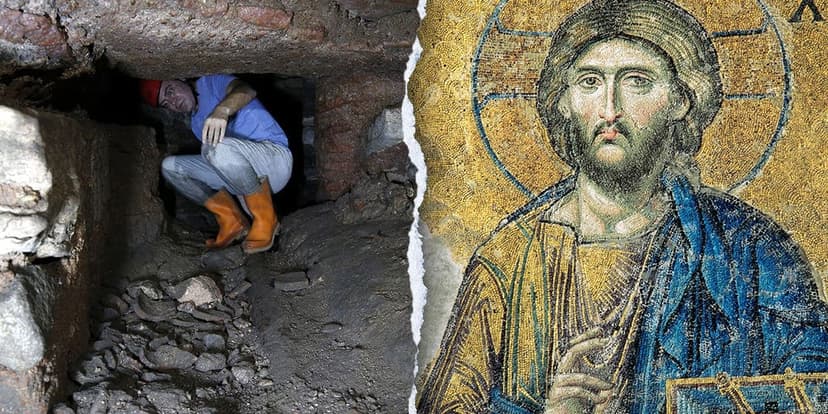
Archaeologists have successfully removed approximately 3,000 tons of debris from an extensive network of underground tunnels situated beneath Istanbul's historic Hagia Sophia. Announced by archaeologist Hasan Fırat Diker, these findings highlight passages that have been inaccessible for centuries.
The revealed tunnels are estimated to be around 1,600 years old and were originally constructed by the Romans. They served crucial functions in the city's water distribution and drainage systems, while also providing protected subterranean spaces.
Significantly, some of these Roman-era structures predate the present-day Hagia Sophia, which was completed in 537 A.D. under Byzantine Emperor Justinian I. The ongoing excavation work, which commenced in February 2025, allows researchers to examine sections of this historic site that were previously buried under mud and debris.
Diker's research has illuminated the intricate design of the tunnels, comparing their complexity to a modern subway system. The network was engineered to channel rainwater from surrounding streets into the sea. Researchers have cleared nearly 558 feet of an underground route connected to a fifth-century Roman street, extending from the Sarayburnu area towards Little Hagia Sophia.
This extensive underground network, part of a UNESCO World Heritage Site, has also yielded findings of an ancient burial complex discovered in 1946. Diker's team excavated an additional five feet beneath this complex, uncovering burial chambers that also predate the current Hagia Sophia, having accumulated substantial mud over centuries.
Future plans include potentially opening more sections of Hagia Sophia's underground network to visitors and organizing an exhibition to showcase the unearthed archaeological remains. Hagia Sophia itself has a rich history, having served as a major center of Eastern Christianity for nearly 1,000 years before its conversion to a mosque in 1453, later becoming a museum in 1935 before reverting to a mosque in 2020.


