Home / Science / 12,000-Year-Old Pyramids? New Theory Rewrites History
12,000-Year-Old Pyramids? New Theory Rewrites History
25 Feb
Summary
- New theory suggests Great Pyramids are 12,000 years old.
- Researcher claims Egyptians only appropriated existing structures.
- Water erosion on Sphinx points to much older origins.
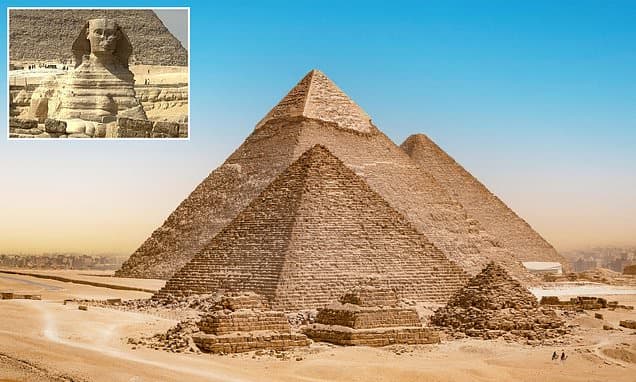
An independent researcher is presenting a theory that the Great Pyramids of Giza may be significantly older than previously believed, potentially dating back 12,000 years. António Ambrósio suggests these monumental structures predate the Egyptian civilization by thousands of years, implying they were constructed by an advanced, unknown global civilization. This groundbreaking idea challenges established historical timelines.
Ambrósio's case highlights several anomalies, including the absence of royal mummies within the pyramids, which contradicts their claimed use as tombs. He also points to the sophisticated engineering and precise astronomical alignments found in the Giza pyramids, feats not replicated by later Egyptian constructions.
Further support for this theory comes from erosion patterns on the Sphinx. Evidence of water erosion suggests heavy rainfall, a climate not seen in Egypt for thousands of years, potentially from 5000 to 3000 BC. This indicates the site was ancient even at the dawn of the Egyptian civilization in 3100 BC.
Ambrósio contends that the ancient Egyptians did not build the primary pyramids but rather appropriated them, with subsequent dynasties attempting to imitate these original structures. He notes the lack of definitive ancient writings directly linking the pharaohs to the pyramids' construction, and casts doubt on the 'Khufu cartouche' as proof, suggesting it may have been a forgery from 1837.
The theory is further supported by comparisons to similar megalithic structures found worldwide, such as Sacsayhuamán in Peru and Baalbek in Lebanon. These global megastructures share characteristics with the Giza pyramids, suggesting a shared ancient supercivilization that mastered advanced building techniques and shared them across early human cultures, potentially embedding coded knowledge.
This fringe theory aligns with concepts like Zep Tepi, an ancient Egyptian mythological 'First Time' or golden age, which some researchers interpret as a real historical period around 10,500 BC. The presence of similar symbols and architectural styles across continents reinforces the idea of a globe-spanning advanced culture that may have existed even further back, between 38,000 and 40,000 years ago.