Home / Science / Galaxies masquerade as alien tech around stars
Galaxies masquerade as alien tech around stars
28 Jul
Summary
- JWST revealed two prime Dyson sphere candidates were galaxies.
- These galaxies perfectly aligned behind stars, mimicking infrared signals.
- The discovery aids future searches for extraterrestrial technology.
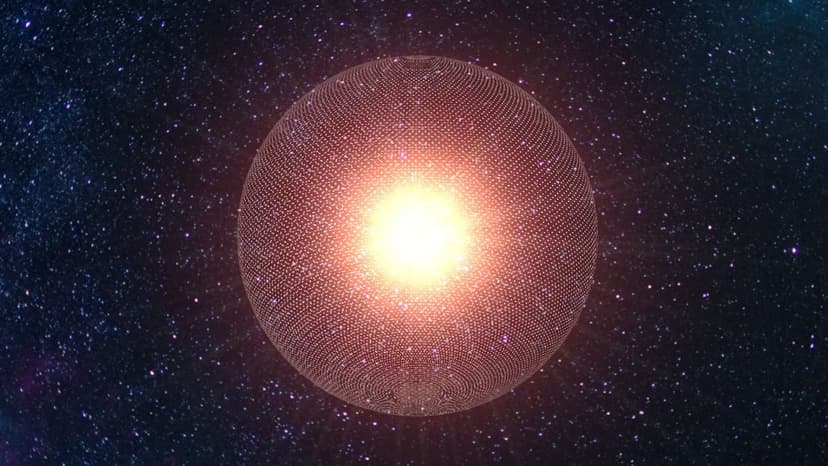
The search for extraterrestrial intelligence has taken a surprising turn as the James Webb Space Telescope (JWST) has revealed two compelling Dyson sphere candidates to be mere cosmic impostors. These candidates, initially flagged for exhibiting unusual infrared excesses, were exposed as ordinary stars obscured by exceptionally bright background galaxies. This breakthrough, announced recently, refines our understanding of technosignatures.
Theoretical Dyson spheres, proposed in 1960, are hypothetical megastructures designed to harness a star's energy. Their presence would cause a detectable 'waste heat' glow in mid-infrared wavelengths. Project Hephaistos sifted through millions of stars, identifying seven potential candidates, with two emerging as most promising for JWST analysis.
JWST's sensitive instruments quickly dismantled the Dyson sphere illusion. For Candidate D, a distant Hot Dust-Obscured Galaxy (Hot DOG) was found almost perfectly aligned behind the star. Candidate E's impostor was a dusty starburst galaxy, whose bright infrared knots unfortunately aligned with the foreground star.
These precise alignments created a convincing facade, fooling even advanced infrared surveys. The galaxies themselves are scientifically valuable discoveries, otherwise potentially missed. This research provides crucial insights into potential false positives, enhancing future searches for alien civilizations by identifying rare, deceptive galactic phenomena.
The techniques developed for this investigation and the understanding of these specific star-galaxy alignments offer significant advantages for upcoming giant telescopes. These celestial coincidences will serve as invaluable guides for observing distant galaxies. This work, while not yielding alien contact, has significantly advanced the methodology for finding extraterrestrial technology.


