Home / Science / Earth's Spin Slowing: Climate Change to Blame
Earth's Spin Slowing: Climate Change to Blame
13 Mar
Summary
- Days are lengthening at 1.33 milliseconds per century, an unprecedented rate.
- Melting ice sheets and rising sea levels are slowing Earth's rotation.
- These changes disrupt systems requiring precise timekeeping like GPS.
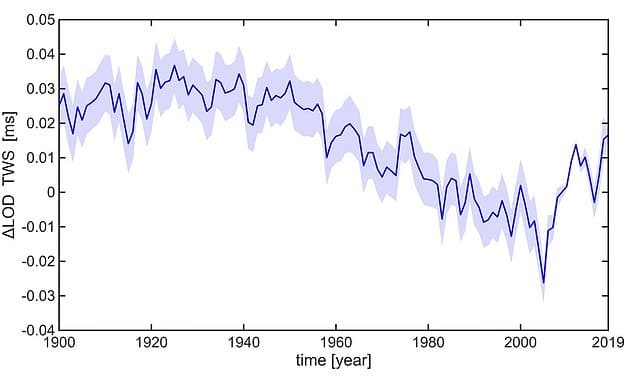
Scientists have discovered that Earth's days are lengthening at an unprecedented rate of 1.33 milliseconds per century. This phenomenon is directly attributed to human-induced climate change, which is causing polar ice sheets and glaciers to melt at an accelerated pace.
The consequence of this melting is rising sea levels. As water from the poles flows towards the equator, it shifts Earth's mass further from its axis of rotation. This redistribution of mass increases the planet's moment of inertia, thereby slowing its spin, much like a figure skater extending their arms to slow down.
While these changes are minute and not noticeable to the human eye, they can cause significant disruptions to systems that rely on extremely precise timekeeping. This includes crucial technologies such as space navigation, GPS, and satellite navigation systems, as well as the synchronization of atomic clocks.
Researchers analyzed fossilized remains of ancient marine organisms to reconstruct past day lengths over the last 3.6 million years. This historical data reveals that no force in this period has altered Earth's rotation as rapidly as humanity's greenhouse gas emissions. Projections indicate that by the end of the 21st century, climate change's impact on day length could exceed that of the moon's gravitational pull.