feedzop-word-mark-logo
searchLogin
Feedzop
homeFor YouUnited StatesUnited States
You
bookmarksYour BookmarkshashtagYour Topics
Trending
Terms of UsePrivacy PolicyAboutJobsPartner With Us

© 2026 Advergame Technologies Pvt. Ltd. ("ATPL"). Gamezop ® & Quizzop ® are registered trademarks of ATPL.

Gamezop is a plug-and-play gaming platform that any app or website can integrate to bring casual gaming for its users. Gamezop also operates Quizzop, a quizzing platform, that digital products can add as a trivia section.

Over 5,000 products from more than 70 countries have integrated Gamezop and Quizzop. These include Amazon, Samsung Internet, Snap, Tata Play, AccuWeather, Paytm, Gulf News, and Branch.

Games and trivia increase user engagement significantly within all kinds of apps and websites, besides opening a new stream of advertising revenue. Gamezop and Quizzop take 30 minutes to integrate and can be used for free: both by the products integrating them and end users

Increase ad revenue and engagement on your app / website with games, quizzes, astrology, and cricket content. Visit: business.gamezop.com

Property Code: 5571

Home / Science / Earth's Core Holds Massive Hydrogen Reservoir

Earth's Core Holds Massive Hydrogen Reservoir

10 Feb

•

Summary

  • Earth's core may contain nine times the amount of hydrogen found in all oceans.
  • Hydrogen comprises an estimated 0.36% to 0.7% of the core's total weight.
  • This suggests Earth acquired most water during its formation, not from comets.
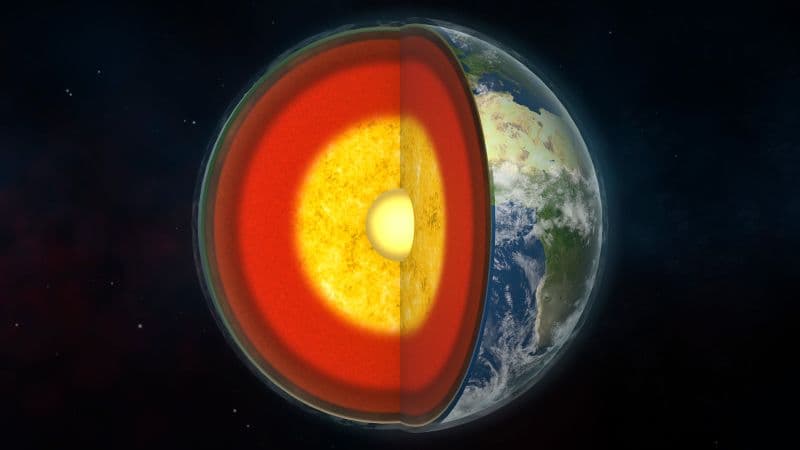
Earth's Core Holds Massive Hydrogen Reservoir

A recent study suggests Earth's core might harbor an immense reservoir of hydrogen, potentially equivalent to nine times the volume of all the planet's oceans. This significant finding indicates that hydrogen could constitute between 0.36% and 0.7% of the core's total weight. Researchers propose that Earth acquired the majority of its water, the primary source of hydrogen, during its initial formation phases rather than through later comet impacts.

This discovery implies that the core, a swirling mass of iron and nickel beneath the mantle and crust, held the most water in the planet's early history. Scientists utilized atom probe tomography, a technique that analyzes samples at the atomic scale, to replicate core temperatures and pressures. By observing how hydrogen interacted with silicon and oxygen in iron nanostructures, they could estimate the core's hydrogen content.

trending

Salesforce lays off 1000

trending

India US trade tariffs slashed

trending

Margot Robbie's Wuthering Heights panned

trending

CBSE board exams: key details

trending

Jana Nayagan movie court case

trending

Dhakshineswar Suresh Davis Cup hero

trending

Deepika Padukone wears Gaurav Gupta

trending

NZ vs UAE match prediction

trending

iPhone 17 Croma Valentine's sale

While this new estimate offers valuable insights, scientists caution that further research is needed to refine the figures. Uncertainties remain regarding potential hydrogen loss during sample decompression and other chemical interactions. Nevertheless, the findings significantly inform our understanding of planetary formation and the distribution of essential elements for life.

Disclaimer: This story has been auto-aggregated and auto-summarised by a computer program. This story has not been edited or created by the Feedzop team.
Researchers estimate that Earth's core could hold a quantity of hydrogen equivalent to nine times the volume of all the planet's oceans.
Hydrogen may make up roughly 0.36% to 0.7% of Earth's total core weight, according to the new estimates.
The findings suggest Earth acquired most of its water during its initial formation, rather than later through comet impacts.

Read more news on

Scienceside-arrow

You may also like

Life's Recipe: Forget Water, Seek Phosphorus!

1 day ago • 4 reads

article image

Critical Minerals: The New Geopolitical Battleground

29 Jan • 88 reads

article image

New Electrode Turns CO2 into Fuel

29 Jan • 36 reads

article image

Greenland's Wealth: Built by Giants

28 Jan • 78 reads

article image

Hidden Danger: Phosphorus Overload in Farmland

26 Jan • 50 reads