feedzop-word-mark-logo
searchLogin
Feedzop
homeFor YouUnited StatesUnited States
You
bookmarksYour BookmarkshashtagYour Topics
Trending
Terms of UsePrivacy PolicyAboutJobsPartner With Us

© 2026 Advergame Technologies Pvt. Ltd. ("ATPL"). Gamezop ® & Quizzop ® are registered trademarks of ATPL.

Gamezop is a plug-and-play gaming platform that any app or website can integrate to bring casual gaming for its users. Gamezop also operates Quizzop, a quizzing platform, that digital products can add as a trivia section.

Over 5,000 products from more than 70 countries have integrated Gamezop and Quizzop. These include Amazon, Samsung Internet, Snap, Tata Play, AccuWeather, Paytm, Gulf News, and Branch.

Games and trivia increase user engagement significantly within all kinds of apps and websites, besides opening a new stream of advertising revenue. Gamezop and Quizzop take 30 minutes to integrate and can be used for free: both by the products integrating them and end users

Increase ad revenue and engagement on your app / website with games, quizzes, astrology, and cricket content. Visit: business.gamezop.com

Property Code: 5571

Home / Science / Ancient Pottery Reveals Math Before Writing

Ancient Pottery Reveals Math Before Writing

16 Jan

•

Summary

  • Pottery up to 8,000 years old features floral designs with petal counts in geometric sequence.
  • Researchers suggest this indicates mathematical thought rooted in symmetry and repetition.
  • This finding predates written mathematical systems by millennia, challenging historical views.
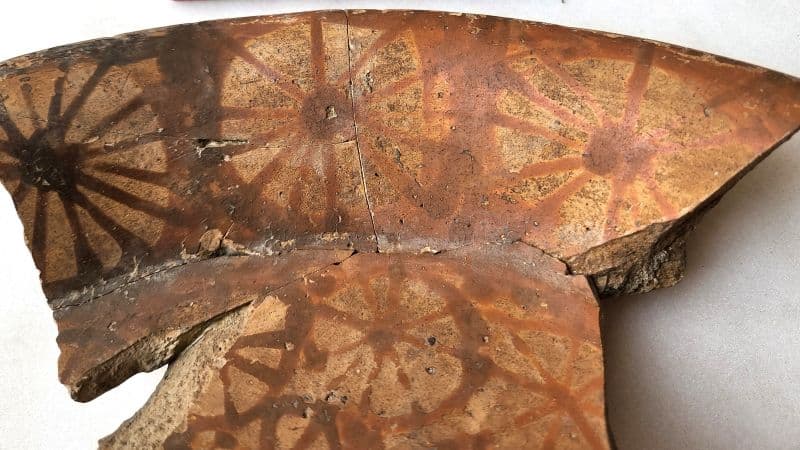
Ancient Pottery Reveals Math Before Writing

Pottery crafted by the ancient Halafian people, dating back as far as 8,000 years ago, may hold the earliest known evidence of human mathematical thinking. Researchers examined hundreds of pottery fragments from northern Mesopotamia, discovering intricate floral patterns with petal counts consistently following a doubling sequence: four, eight, 16, 32, and 64.

This strict adherence to a geometric progression across numerous sites and over vast distances suggests intentional mathematical reasoning rooted in symmetry and repetition. The Halafians' ability to divide space evenly, reflected in these motifs, likely stemmed from practical needs like resource allocation in their complex village communities. This discovery challenges traditional timelines, as it predates undisputed written mathematical systems by several millennia.

trending

Shots fired near CDC HQ

trending

NEA: Electric coops receive loans

trending

UDA Nationals dance competition

trending

Micron invests $100B in NY

trending

Dembélé scores twice for PSG

trending

Al-Ittihad vs Al-Ettifaq preview

trending

Rocket Lab stock soars

trending

Hoosiers head to championship game

trending

Monaco faces Lorient absentees

The findings contribute to ethnomathematics, the study of mathematical knowledge embedded in cultural expressions. While some experts caution that the symmetry might be a simple division technique, the researchers argue it represents a foundational step in human cognition, demonstrating that complex thought and mathematical concepts emerged long before the advent of writing.

Disclaimer: This story has been auto-aggregated and auto-summarised by a computer program. This story has not been edited or created by the Feedzop team.
The Halafian pottery features floral designs with petal counts in a doubling sequence, suggesting early mathematical reasoning based on symmetry and repetition.
The Halafian people lived in northern Mesopotamia between 6200 BC and 5500 BC.
The study suggests that pottery made by the Halafian people up to 8,000 years ago shows the earliest example of humans' mathematical thought.

Read more news on

Scienceside-arrow

You may also like

Stone Age Horns Speak: 6,000-Year Communication Revived

13 Jan • 14 reads

article image

Africa Birthplace of Humanity: New Fossils Rewrite History

7 Jan • 67 reads

article image

Neanderthals Mastered Fire 400,000 Years Ago

10 Dec, 2025 • 161 reads

article image

Rare 3rd-Century Jesus Fresco Found in Turkish Necropolis

11 Dec, 2025 • 170 reads

article image

Lost Bronze Age Culture Discovered in Turkey

10 Dec, 2025 • 192 reads

article image