


Home / Science / Universe's Dark Matter: Black Holes from Another Reality?
Universe's Dark Matter: Black Holes from Another Reality?
15 Apr
Summary
- Dark matter may be ancient black holes from a prior universe.
- This theory suggests the Big Bang was a 'bounce,' not an absolute start.
- Relic black holes could explain rapid early galaxy growth seen by JWST.
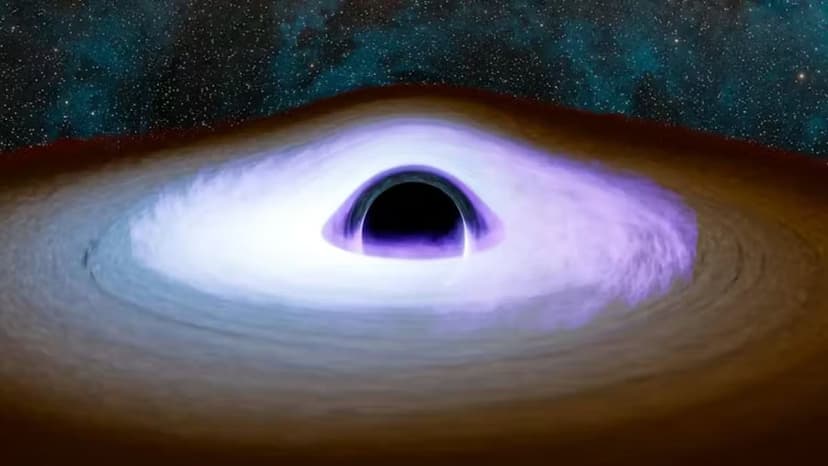
A scientist has proposed a radical theory suggesting that dark matter might not be an undiscovered particle, but rather ancient black holes originating from a universe that predates our own. This 'relic' black hole hypothesis posits that these objects, small yet massive and invisible except through gravity, could constitute the 27% of the universe's mass attributed to dark matter.
The theory is underpinned by the idea of a 'bouncing' universe, where the Big Bang was not the absolute beginning but a transition point following the collapse of a previous cosmic phase. Professor Enrique Gaztanaga suggests these relic black holes would have survived this cosmic transition and seamlessly fit the observed gravitational effects of dark matter.
This concept offers solutions to significant cosmological puzzles. It negates the need for an infinitely dense singularity at the Big Bang and provides an explanation for the unusually large and bright early galaxies detected by the James Webb Space Telescope. These 'relic' black holes would have had a substantial head start in growth.
Further research is needed to validate this theory through gravitational wave data and Cosmic Microwave Background measurements. If confirmed, it would simultaneously resolve major mysteries surrounding both dark matter and the early universe's rapid development, presenting a unified explanation for phenomena that challenge current models.
