Home / Science / Dying Star's Cosmic Ballet: A Crystal Ball Nebula
Dying Star's Cosmic Ballet: A Crystal Ball Nebula
9 Jun
Summary
- New image shows a dying star in a binary system.
- The Crystal Ball Nebula is 1,500 light-years away.
- A companion star shapes the dying star's gas.
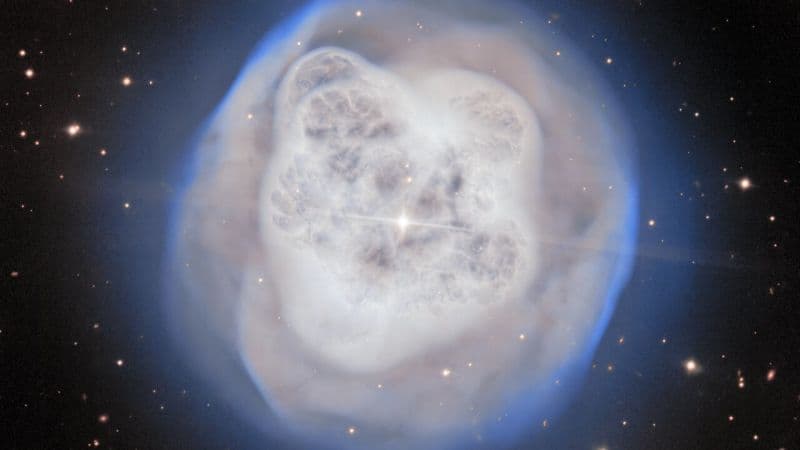
A recent image from the Gemini North telescope in Hawaii offers a spectacular view of the Crystal Ball Nebula, located approximately 1,500 light-years from Earth. This planetary nebula is formed by a dying star within a binary system, where its companion star influences the ejection of stellar material.
The two-star system creates the nebula's distinct, cloudlike formations as the orbiting star churns the gas shed by its partner. This process results in vivid colors, with red hues indicating hot hydrogen and blue indicating hot oxygen. Planetary nebulae, named for their planetlike appearance in small telescopes, represent a brief, albeit visually striking, phase in a star's life cycle.
Scientists continue to study planetary nebulae, such as the Crystal Ball Nebula, because their dying phase lasts only about 10,000 years. This allows for observations of changing temperatures, mass loss, and expansion into space, providing valuable insights into stellar evolution. The nebula was first spotted by astronomer William Herschel in 1790.


