Home / Science / Early Universe Unveiled: New Cosmic Simulation
Early Universe Unveiled: New Cosmic Simulation
27 Oct
Summary
- Simulation charts dark matter and gas 1.5 billion years after Big Bang.
- Lumina visualizes the universe's evolution from cold gas to early galaxies.
- New visuals help compare physics understanding across cosmic time.
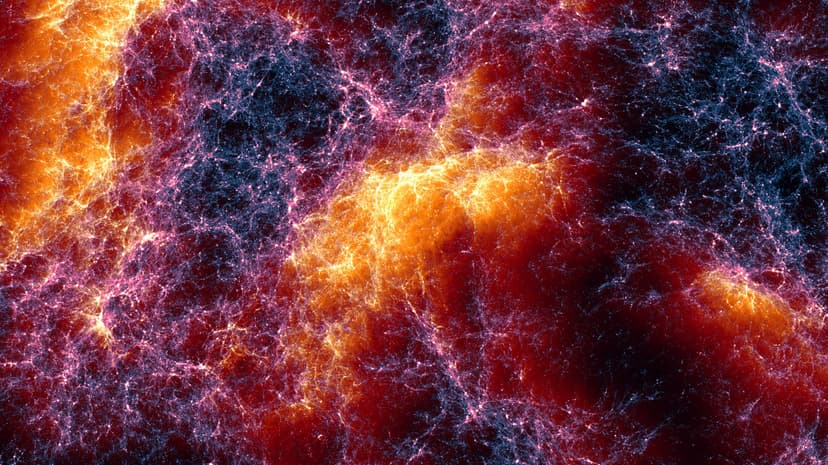
Sweeping new visualizations from the Lumina simulation provide one of the most detailed views yet of the early cosmos. These images depict the dynamic interplay of dark matter and hot gaseous hydrogen and helium approximately 1.5 billion years after the Big Bang.
The simulation charts the universe's evolution between 50 million and 2 billion years post-Big Bang. Lumina illustrates the transition from a nearly uniform state of cold, neutral gas to an environment populated by early galaxies, developing black holes, and a diffuse haze of ionized matter.
Scientists are utilizing these detailed simulations to compare with observations from NASA's James Webb Space Telescope. This comparison allows astronomers to test whether fundamental physics principles hold true across vast stretches of cosmic time, offering insights into galaxy formation when the first stars and galaxies were emerging.


