feedzop-word-mark-logo
searchLogin
Feedzop
homeFor YouUnited StatesUnited States
You
bookmarksYour BookmarkshashtagYour Topics
Trending
Terms of UsePrivacy PolicyAboutJobsPartner With Us

© 2026 Advergame Technologies Pvt. Ltd. ("ATPL"). Gamezop ® & Quizzop ® are registered trademarks of ATPL.

Gamezop is a plug-and-play gaming platform that any app or website can integrate to bring casual gaming for its users. Gamezop also operates Quizzop, a quizzing platform, that digital products can add as a trivia section.

Over 5,000 products from more than 70 countries have integrated Gamezop and Quizzop. These include Amazon, Samsung Internet, Snap, Tata Play, AccuWeather, Paytm, Gulf News, and Branch.

Games and trivia increase user engagement significantly within all kinds of apps and websites, besides opening a new stream of advertising revenue. Gamezop and Quizzop take 30 minutes to integrate and can be used for free: both by the products integrating them and end users

Increase ad revenue and engagement on your app / website with games, quizzes, astrology, and cricket content. Visit: business.gamezop.com

Property Code: 5571

Home / Science / Cosmic Enigma: 'Cloud-9' Could Reveal Dark Matter's Nature

Cosmic Enigma: 'Cloud-9' Could Reveal Dark Matter's Nature

9 Jan

•

Summary

  • A newly discovered object, nicknamed Cloud-9, might be a remnant of early galaxy formation.
  • This starless cloud offers a rare glimpse into dark matter's elusive properties.
  • Future studies of Cloud-9 could unlock secrets of dark matter and cosmic evolution.
Cosmic Enigma: 'Cloud-9' Could Reveal Dark Matter's Nature

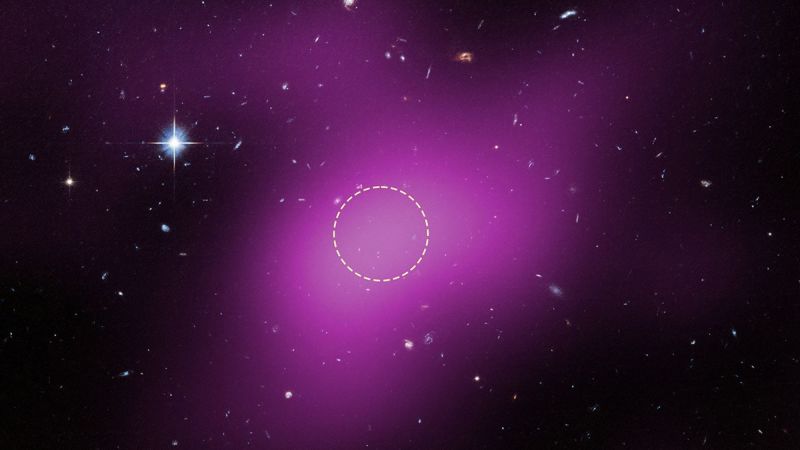
Astronomers have identified a potential new type of celestial object, nicknamed Cloud-9, which could be instrumental in understanding dark matter. This enigmatic substance, thought to comprise 85% of the universe's mass, shapes the cosmos but has never been directly observed. Cloud-9's significance lies in its potential to be a primordial remnant from the universe's early formation stages.

Observations, including those from the Hubble Space Telescope, revealed Cloud-9 to be entirely starless, defying typical galaxy formation models. This 'failed galaxy' is rich in dark matter, estimated at 5 billion solar masses, with only about 1 million solar masses of neutral hydrogen. Scientists believe it exists in a delicate balance, possessing enough mass to retain its gas but not enough to initiate star formation.

trending

Unemployment rate dipped to 4.4%

trending

Las Vegas freeze warning issued

trending

ASTS satellites defense communication growth

trending

December jobs report release

trending

Pakistan leads series against SriLanka

trending

Cubs sign Edward Cabrera

trending

Rural dentist recruitment challenge

trending

Meta invests in Oklo stock

trending

Frore Systems demos Liquidjet

Discovered three years ago near the Messier 94 galaxy, Cloud-9's unique characteristics are prompting further investigation. While some suggest it might be an exceptionally faint galaxy, its starless nature points towards a significant dark matter component. Future observations aim to resolve its core and potentially confirm its dark matter dominance, offering a crucial window into the universe's fundamental mysteries.

Disclaimer: This story has been auto-aggregated and auto-summarised by a computer program. This story has not been edited or created by the Feedzop team.
Cloud-9 is a potential new type of astronomical object, thought to be a starless cloud rich in dark matter, possibly a remnant from early galaxy formation.
Cloud-9 offers a rare, direct observation of a dark matter-dominated cloud, providing insights into its properties and role in cosmic structure.
The Messier 94 galaxy is located 16 million light-years away from Earth, and Cloud-9 was initially discovered on its outskirts.

Read more news on

Scienceside-arrow

You may also like

Ancient Comet Older Than Sun Stuns Scientists

6 Jan • 30 reads

article image

Hubble Spots Cosmic Star Nursery

1 Jan • 54 reads

article image

Exotic Exoplanet Orbits Dead Star, Stretches to Lemon Shape

19 Dec, 2025 • 109 reads

article image

Cosmic Crashes Spotted: Hubble Reveals Space Rock Collisions

19 Dec, 2025 • 120 reads

article image

Interstellar Comet Nears Earth!

16 Dec, 2025 • 175 reads

article image