Home / Science / Distant Signals Reveal Cosmic Dance: Binary Stars Behind FRBs?
Distant Signals Reveal Cosmic Dance: Binary Stars Behind FRBs?
28 Jan
Summary
- Some fast radio bursts may originate from binary star systems.
- An 'RM flare' observed by FAST telescope indicated a companion star.
- The findings challenge previous assumptions about FRB origins.

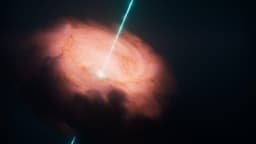
A groundbreaking discovery by an international research team suggests that some fast radio bursts (FRBs) may originate in binary star systems. These powerful, millisecond-long radio wave flashes, previously thought to emanate from single stars, have now been linked to pairs of stars orbiting each other.
The team utilized the Five-hundred-meter Aperture Spherical Telescope (FAST), also known as the 'China Sky Eye,' to observe a repeating FRB approximately 2.5 billion light-years away. During nearly 20 months of monitoring, an unusual event termed an 'RM flare' was detected. This involved a dramatic shift in the radio signal's polarization properties.
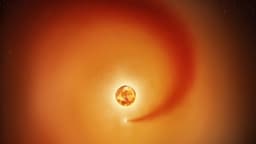
Researchers propose this flare was caused by a coronal mass ejection from a companion star, sending a dense, magnetized plasma cloud through the line of sight. This finding strongly supports a binary system containing a magnetar and a Sun-like star. The observations also relied on Australia's Parkes telescope.
This discovery reshapes long-standing assumptions about the origin and production of FRBs. While most FRBs are detected only once, repeating FRBs offer rare opportunities for study. The findings were published in the journal Science and were supported by various national and international grants.