feedzop-word-mark-logo
searchLogin
Feedzop
homeFor YouUnited StatesUnited States
You
bookmarksYour BookmarkshashtagYour Topics
Trending
Terms of UsePrivacy PolicyAboutJobsPartner With Us

© 2026 Advergame Technologies Pvt. Ltd. ("ATPL"). Gamezop ® & Quizzop ® are registered trademarks of ATPL.

Gamezop is a plug-and-play gaming platform that any app or website can integrate to bring casual gaming for its users. Gamezop also operates Quizzop, a quizzing platform, that digital products can add as a trivia section.

Over 5,000 products from more than 70 countries have integrated Gamezop and Quizzop. These include Amazon, Samsung Internet, Snap, Tata Play, AccuWeather, Paytm, Gulf News, and Branch.

Games and trivia increase user engagement significantly within all kinds of apps and websites, besides opening a new stream of advertising revenue. Gamezop and Quizzop take 30 minutes to integrate and can be used for free: both by the products integrating them and end users

Increase ad revenue and engagement on your app / website with games, quizzes, astrology, and cricket content. Visit: business.gamezop.com

Property Code: 5571

Home / Science / Grain-of-Sand Robots Powered by Light Developed

Grain-of-Sand Robots Powered by Light Developed

7 Jan

•

Summary

  • Researchers created autonomous microrobots smaller than a grain of salt.
  • These robots independently navigate liquids using only light for power.
  • They combine sensing, computing, and movement in a single system.
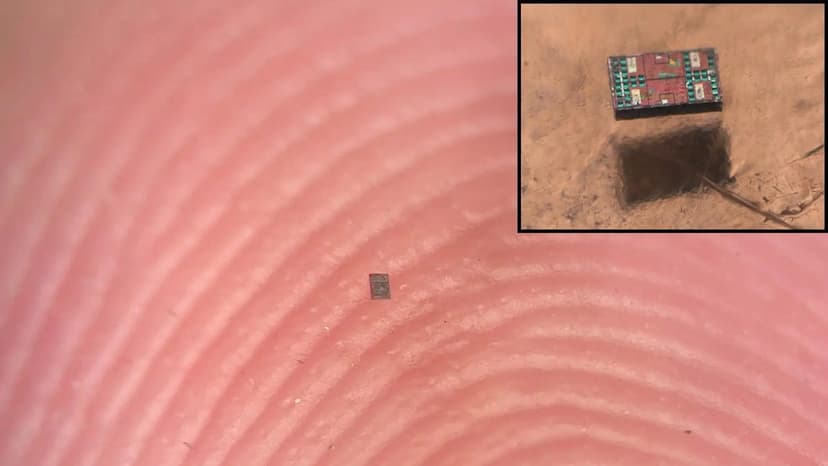
Grain-of-Sand Robots Powered by Light Developed

Scientists have engineered groundbreaking autonomous microrobots, measuring just 200 by 300 micrometers. These devices operate independently within liquids, utilizing light as their sole power source. This innovation marks a significant leap, enabling programmable robots at an unprecedented scale.

The microrobots generate miniature electrical fields to propel themselves through fluids, a method suited for the microscopic realm. Unlike previous iterations requiring external guidance, these new robots integrate their own solar-powered processors. This allows for environmental sensing, communication through patterned movements, and autonomous task execution.

Potential applications span cellular-level biological monitoring, medical diagnostics, and the assembly of minuscule devices. Due to their cost-effective mass production, these microrobots promise to unlock new avenues for research and engineering in previously inaccessible microscopic domains.


trending

Bitcoin price struggles amid fragility

trending

Buddha relics travel from Vadodara

trending

Mrunal Thakur wedding rumours

trending

Suzlon Energy Q3 results up

trending

Savannah Guthrie pleads for mother

trending

Australia vs Netherlands warm-up

trending

RCB wins WPL match

trending

Bas de Leede admires Pandya

Disclaimer: This story has been auto-aggregated and auto-summarised by a computer program. This story has not been edited or created by the Feedzop team.
Researchers from the University of Pennsylvania and the University of Michigan developed these autonomous microrobots.
The microrobots are powered entirely by light, using miniature solar cells and generating electrical fields for movement.
Potential applications include monitoring biological processes, aiding medical diagnostics, and assembling micro-devices.

Read more news on

Scienceside-arrowArtificial Intelligence (AI)side-arrow

You may also like

AI Agents Explode: Budgets Swell 19% Amidst Integration Woes

15 hours ago • 3 reads

article image

Lobster Bot Rises: AI's New Digital Butler

28 Jan • 40 reads

article image

Humanoid Robots: Closer Than You Think?

8 Jan • 151 reads

article image

AI Agents: Hype vs. Reality in 5 Years

2 Jan • 203 reads

article image

Home Robots: Still Science Fiction?

1 Jan • 153 reads

article image