Home / Science / Astronomers Witness Unprecedented Stellar Eruption from Distant Red Dwarf Star
Astronomers Witness Unprecedented Stellar Eruption from Distant Red Dwarf Star
16 Nov
Summary
- Astronomers detect first-ever coronal mass ejection from a star beyond our solar system
- The explosive event was 10-100,000 times more powerful than the strongest solar storms
- The rapid burst of material could potentially strip the atmosphere of any nearby exoplanet
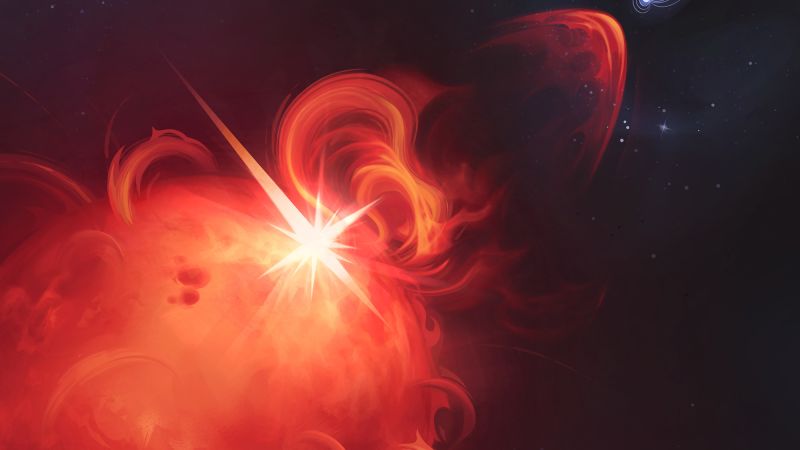
In a groundbreaking discovery, astronomers have detected the first-ever coronal mass ejection (CME) from a star beyond our solar system. The explosive event, observed from a red dwarf star named StKM 1-1262 located 130 light-years from Earth, was 10 to 100,000 times more powerful than the strongest solar storms.
The stellar storm was launched at a blazing speed of 5.3 million miles per hour (2,400 kilometers per second), a velocity only seen in about 1 in every 2,000 CMEs released from our sun. This rapid burst of material was powerful enough that it could potentially strip away the atmosphere of any closely orbiting planet, posing a serious threat to the habitability of such worlds.
The detection of this extrasolar CME was made possible by a new analysis technique called Radio Interferometric Multiplexed Spectroscopy (RIMS), developed by the research team. By sifting through data from the Low Frequency Array (LOFAR) radio telescope, the scientists were able to identify the telltale radio signal of the CME as it swept through the outer atmosphere of the star.
The findings, published in the journal Nature, provide crucial insights into the violent activity of stars and its potential impact on exoplanets. As astronomers continue to search for potentially habitable worlds beyond our solar system, understanding the effects of such powerful stellar eruptions will be crucial in determining the suitability of these distant planets for life.