

Home / Science / Artemis II: Fireball Re-entry Risks Ahead
Artemis II: Fireball Re-entry Risks Ahead
9 Apr
Summary
- Astronauts face extreme heat and communication blackout during re-entry.
- Heat shield integrity is critical, with no backup plan.
- Artemis I mission revealed significant heat shield damage.
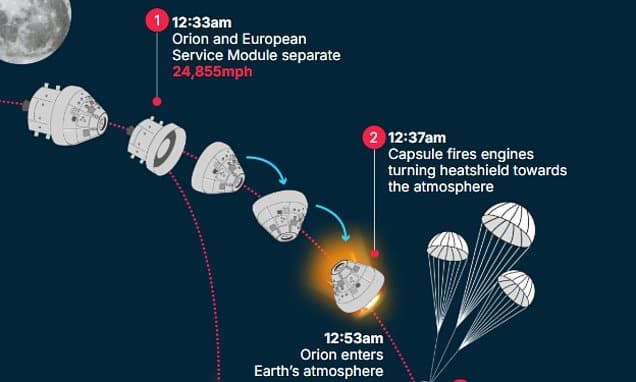
The Artemis II crew is nearing the conclusion of their historic lunar journey. Their return to Earth involves a high-stakes atmospheric re-entry, a phase considered the most dangerous of the mission. The Orion module will detach from its service module and plunge into Earth's atmosphere at approximately 25,000 mph.
During this fiery descent, the spacecraft will be enveloped in plasma, causing a temporary but tense communication blackout with mission control. The astronauts' survival hinges on a mere three-inch heat shield, designed to withstand searing temperatures nearing 2,760°C. NASA officials have stressed the critical nature of this shield, stating there is 'no plan B' if it fails.
Concerns are heightened by findings from the uncrewed Artemis I mission, where the heat shield lost material in over 100 locations and experienced melting. Engineers have adjusted the re-entry trajectory for Artemis II, aiming for a faster passage through the atmosphere to minimize heat exposure. The entire re-entry and splashdown sequence is expected to take about 13 minutes.
The crew, consisting of Reid Wiseman, Victor Glover, Christina Koch, and Jeremy Hansen, will deploy parachutes to slow their descent before splashing down in the Pacific Ocean. This mission, the first to send astronauts toward the Moon since 1972, has been largely successful, with a minor issue reported with the onboard toilet.
NASA aims to return humans to the Moon by 2028, anticipating competition from China's lunar ambitions around 2030. The astronauts have described their experience as profound and are anticipating a lengthy period of reflection on their journey.
