Home / Science / Scientists Crack Arctic Ice Vibration Code for Safer Platforms
Scientists Crack Arctic Ice Vibration Code for Safer Platforms
16 Mar
Summary
- New model predicts dangerous ice vibrations on Arctic structures.
- It accounts for water-ice mixture in fracture zones.
- Helps engineers prevent resonance and chaotic behavior.
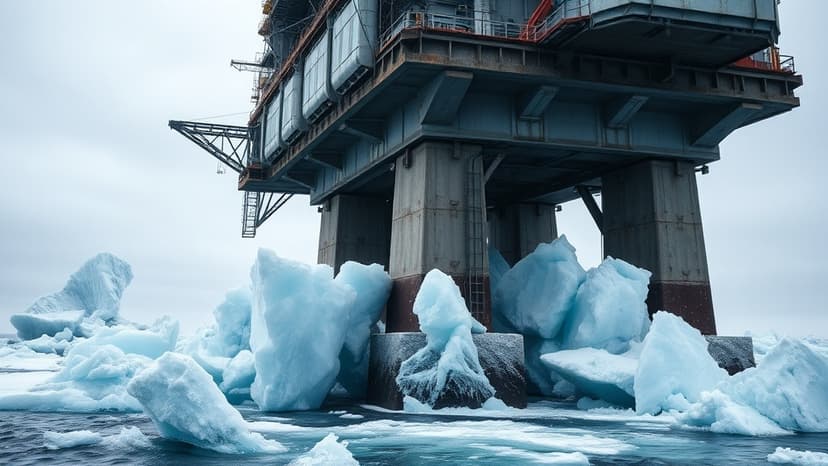
A novel model has been developed by scientists to predict vibration conditions for engineering structures operating in Arctic icy environments. This advancement aims to significantly reduce damage risks by providing a theoretical basis for assessing forces influenced by ice speed, strength, and the properties of water-ice mixtures in fracture zones.
The model offers a more accurate prediction of dangerous operational modes during the design stage. Engineers can now assess the potential for resonance or chaotic behavior based on structure parameters and local ice conditions. If risks are identified, designs can be adjusted to shift potential danger zones away from realistically possible ice drift speeds.
Existing models often simplified ice as monolithic and water as merely added mass, neglecting the crucial interaction in the contact area. The new approach incorporates a detailed description of the destruction zone, acknowledging the crumbling of ice into a complex water-ice fragment mixture. This detailed understanding allows for the accurate description of three classical modes of ice vibrations: intermittent crushing, resonant frequency capture, and continuous brittle crushing.
Analytical results indicate that the transition between these modes depends on the competition between ice impact frequency and energy dissipation rates. At lower speeds, periodic fluctuations occur. As speed increases to a critical level, resonance leads to sharp amplitude increases. At even higher speeds, rapid impacts prevent energy dissipation, resulting in chaotic, broadband fluctuations.