Home / Science / Nobel Laureate Leggett Unlocked Helium's Secrets
Nobel Laureate Leggett Unlocked Helium's Secrets
12 Mar
Summary
- Leggett explained helium-3's superfluidity, a previously impossible feat.
- His interpretation was crucial to a Nobel Prize-winning discovery.
- He later won his own Nobel for superconductor and superfluid theories.
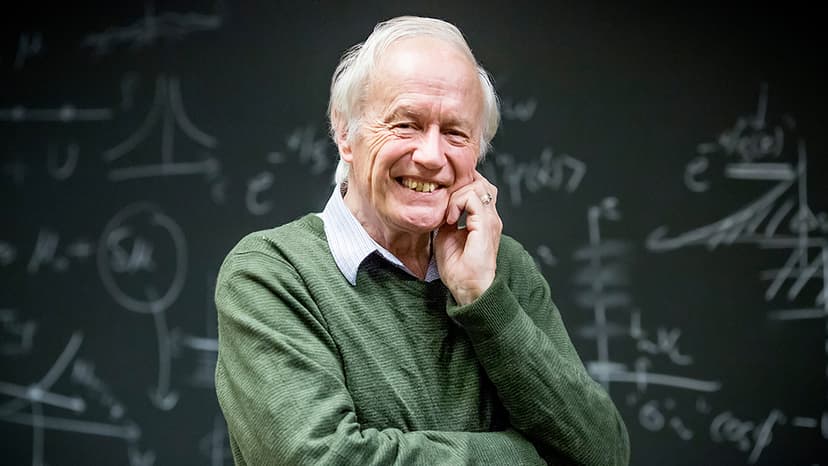
Physicist Anthony J. Leggett, a Nobel laureate, died on Sunday at his home in Urbana, Ill., at the age of 87. He was recognized for his pivotal role in understanding superfluids, a state where liquids exhibit frictionless flow.
In 1972, Leggett deciphered puzzling experimental results from Cornell physicists, realizing they had achieved a superfluid state with helium-3, a feat previously considered impossible. His groundbreaking papers in Physical Review Letters in October 1972 and August 1973 provided the theoretical framework and predictions that confirmed this scientific breakthrough.
This interpretation was so crucial that it was cited by the Nobel committee when awarding the 1996 Nobel Prize in Physics to the experimentalists. Seven years later, Leggett himself received the Nobel Prize in Physics in 2003 for his broader contributions to the theory of superconductors and superfluids, with his work having implications in fields like cosmology and turbulence. He joined the University of Illinois Urbana-Champaign faculty in 1983, contributing to research on quantum dissipation through the Caldeira-Leggett model.