Home / Science / Antarctica's Gravity Hole Mystery Solved!
Antarctica's Gravity Hole Mystery Solved!
17 Feb
Summary
- A massive Antarctic gravity hole has scientists baffled.
- Slow rock movements from 70 million years ago explain the dip.
- This anomaly impacts sea levels and may affect ice sheets.
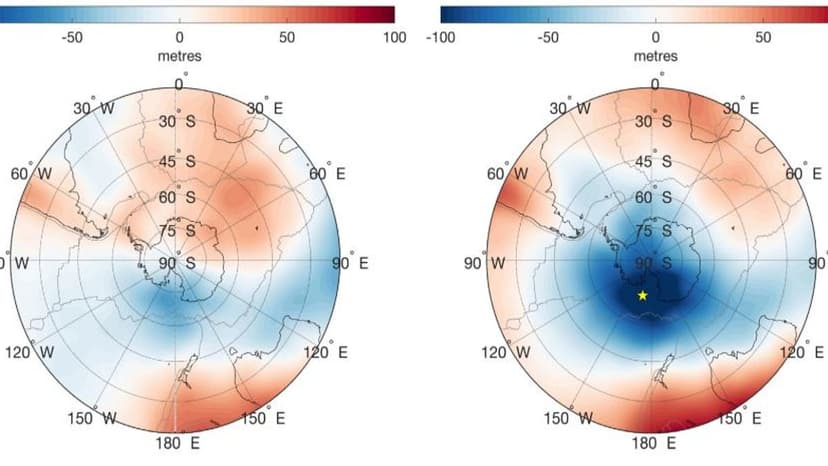
A significant gravity anomaly, known as the Antarctic Geoid Low (AGL), located deep beneath Antarctica's ice, has long puzzled scientists. New research suggests this phenomenon is caused by incredibly slow rock movements deep within the Earth.
The formation of this gravity hole began around 70 million years ago, a period when dinosaurs still roamed the planet. Less-dense rock accumulated beneath the continent, gradually weakening the gravitational pull. The anomaly then intensified significantly between 50 and 30 million years ago.
This gravitational weakness causes the ocean's surface to dip about 420 feet (130 m) below the surrounding sea level. Researchers utilized earthquake recordings and a sophisticated computer model to map the anomaly's formation over millions of years.
Scientists are exploring potential connections between the AGL's strengthening and the rapid advance of Antarctica's ice sheets during the Eocene Epoch. Further research aims to understand how Earth's internal structure influences gravity, sea levels, and the stability of large ice sheets, potentially revealing links between deep-earth processes and climate.