Home / Science / Stone Age Marks Hint at Writing's Ancient Roots
Stone Age Marks Hint at Writing's Ancient Roots
25 Feb
Summary
- Stone Age humans carved complex symbols over 40,000 years ago.
- Marks on artifacts show similar information density to early writing.
- Symbols offer evidence of advanced cognitive abilities in early humans.
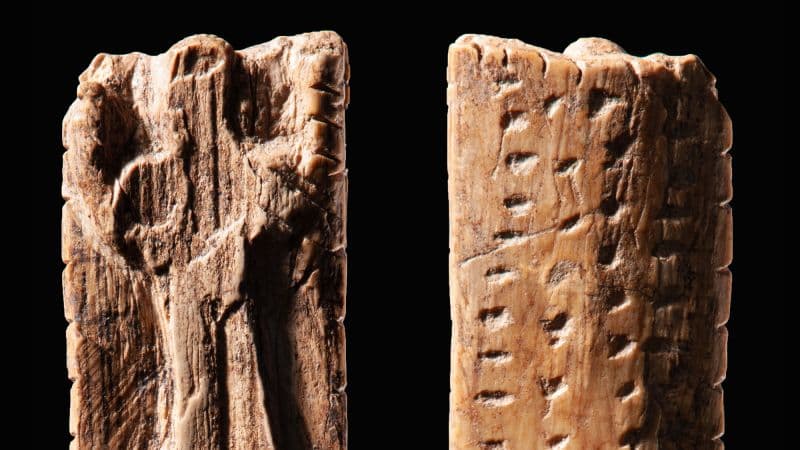
Over 40,000 years ago, Stone Age humans in Germany created symbols and markings on artifacts that may represent an ancient precursor to writing. A new analysis of 260 items from the Swabian Alps reveals geometric signs such as crosses, dots, notches, and lines carved into ivory, bone, and antler. These markings exhibit a complexity and information density comparable to proto-cuneiform script, an early writing system that emerged in Mesopotamia around 5,300 years ago.
The study utilized computer-assisted methods to analyze approximately 3,000 signs found on tools and figurines. While the exact meaning of these ancient symbols remains uncertain, researchers observed patterns and logical associations, such as the absence of crosses on human figurines. Some figurines, depicting human-lion hybrids or human figures with sequences of notches and dots, suggest a developing system for conveying information beyond mere decoration.
These findings, published in PNAS, indicate that early modern humans in Europe possessed sophisticated cognitive abilities, including the capacity to develop sign systems. This challenges the notion of writing as a singular, late achievement and suggests that the mental foundations for transforming information into codes are much older than previously believed. The markings imply a level of behavioral modernity in Stone Age populations that aligns with contemporary human capabilities.