feedzop-word-mark-logo
searchLogin
Feedzop
homeFor YouUnited StatesUnited States
You
bookmarksYour BookmarkshashtagYour Topics
Trending
trending

Taipei mass stabbing kills four

trending

Colorado power shutoffs evaluated

trending

Fog warning in Himachal Pradesh

trending

Myanmar hit by magnitude 4.4 earthquake

trending

YouTube and Google faced outages

trending

Rocket Lab stock surges

trending

Target app outage reported

trending

Metro Detroit school closings Friday

trending

Slippery road conditions expected

Terms of UsePrivacy PolicyAboutJobsPartner With Us

© 2025 Advergame Technologies Pvt. Ltd. ("ATPL"). Gamezop ® & Quizzop ® are registered trademarks of ATPL.

Gamezop is a plug-and-play gaming platform that any app or website can integrate to bring casual gaming for its users. Gamezop also operates Quizzop, a quizzing platform, that digital products can add as a trivia section.

Over 5,000 products from more than 70 countries have integrated Gamezop and Quizzop. These include Amazon, Samsung Internet, Snap, Tata Play, AccuWeather, Paytm, Gulf News, and Branch.

Games and trivia increase user engagement significantly within all kinds of apps and websites, besides opening a new stream of advertising revenue. Gamezop and Quizzop take 30 minutes to integrate and can be used for free: both by the products integrating them and end users

Increase ad revenue and engagement on your app / website with games, quizzes, astrology, and cricket content. Visit: business.gamezop.com

Property Code: 5571

Home / Science / AI Robots Revolutionize Chemistry Labs Overnight

AI Robots Revolutionize Chemistry Labs Overnight

3 Dec

•

Summary

  • AI-driven robots now conduct chemistry experiments autonomously, even overnight.
  • UK professors Cooper and Cronin lead AI robotics in distinct, scalable approaches.
  • AI automation aims to shift research from 80% experiment to 80% virtual design.
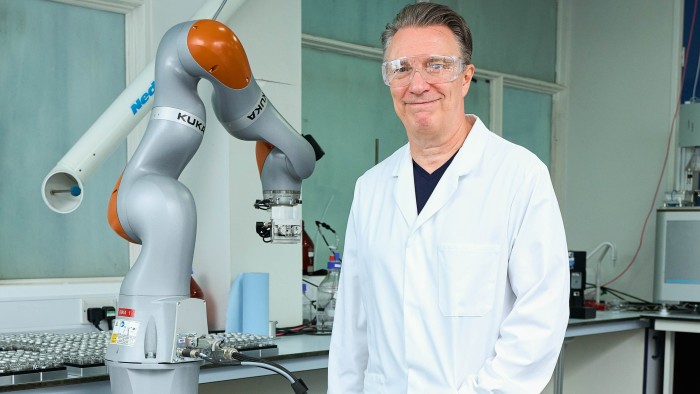
AI Robots Revolutionize Chemistry Labs Overnight

Chemistry labs are embracing AI-driven robotics, with autonomous robots now conducting experiments around the clock. These intelligent systems analyze results and decide on next steps, even during non-working hours, dramatically enhancing productivity and accelerating discovery in fields from drug development to materials science. Leading this revolution are UK professors Andy Cooper and Lee Cronin, who are pioneering different scalable approaches. Cooper integrates industrial robots into existing lab setups, while Cronin's spinout, Chemify, develops bespoke facilities and a digital chemistry programming language, aiming for on-demand molecule creation. This shift towards AI automation is poised to fundamentally alter research methodologies, potentially moving from 80% experimental work to 80% virtual design. While AI augments human capabilities, experts emphasize that creativity and deeper reasoning remain distinctly human contributions, shaping a future of "hybrid intelligence" in science.


Disclaimer: This story has been auto-aggregated and auto-summarised by a computer program. This story has not been edited or created by the Feedzop team.
AI robots in labs like Professor Cooper's autonomously conduct experiments and analyze results 24/7, significantly boosting productivity.
Professor Cronin's Chemify aims to design and make any molecule on demand, revolutionizing chemical discovery and manufacturing through AI.
No, AI is expected to augment human scientists, freeing them from tedious tasks to focus on creativity, innovation, and deeper scientific reasoning.

Read more news on

Scienceside-arrow

You may also like

Biffy Clyro Bassist Withdraws From Tour Due to Mental Health

15 Dec • 17 reads

article image

Stephen King's 'The Long Walk': Casting a Grim Marathon

11 Dec • 30 reads

article image

Citi Shakes Up Leadership: New CFO Named Amid Restructuring

21 Nov • 128 reads

article image

Friendship Fuels Filmmaking: Cooper and Arnett's Creative Partnership Shines in 'Is This Thing On?'

17 Nov • 106 reads

article image

Vet's 6 Tricks to Slash Soaring Pet Care Costs in 2025

11 Nov • 110 reads

article image