Home / Science / AI Predicts Battery Breakthroughs Instantly
AI Predicts Battery Breakthroughs Instantly
8 Mar
Summary
- Machine learning accelerates discovery of advanced battery materials.
- Raman spectroscopy identifies fast ion conductors for solid-state batteries.
- New method simulates complex materials, reducing computational cost.
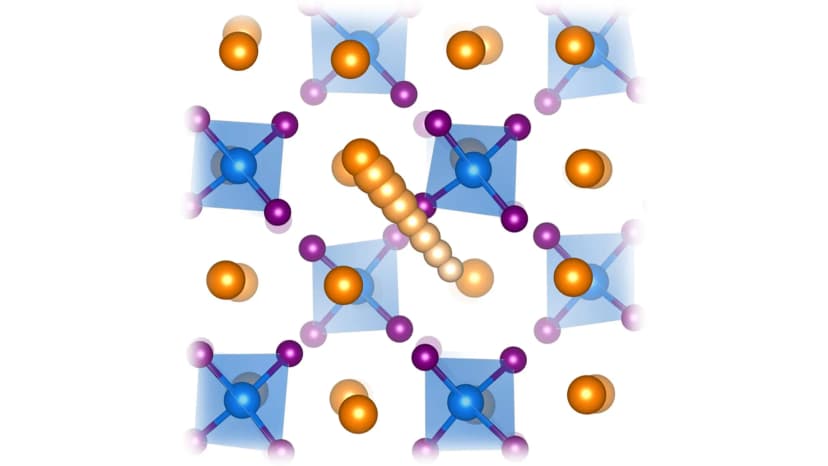
Researchers have developed a novel machine learning (ML) accelerated workflow to expedite the discovery of advanced battery materials. This innovative method combines ML force fields with tensorial ML models to simulate Raman spectra, a key indicator of ionic conductivity in materials.
The ML approach has proven effective in identifying materials with liquid-like ionic conduction by analyzing strong low-frequency Raman intensity. This spectral feature signals symmetry breaking caused by rapid ion transport, directly correlating with high ionic mobility.
This new technique allows for the simulation of vibrational spectra of complex and disordered materials at realistic temperatures with near-ab initio accuracy. This significantly reduces the computational cost associated with traditional methods, making large-scale studies practical. The findings, published in AI for Science, could accelerate the development of high-performance solid-state battery technologies.
The study successfully identified Raman signatures linked to liquid-like ion motion in sodium-ion conducting systems. Materials exhibiting strong low-frequency Raman features also demonstrated high ionic diffusivity, distinguishing them from materials with ion transport via hopping mechanisms. This provides a broader framework for interpreting diffusive Raman scattering across various material classes.
By enabling a faster evaluation of candidate materials, this data-driven strategy offers a powerful new route for energy storage research. The development of high-performance solid-state battery technologies is expected to benefit significantly from this accelerated discovery process.