Home / Health / DIY Mole Removal: Doctors Warn of Dangerous Risks
DIY Mole Removal: Doctors Warn of Dangerous Risks
14 Feb
Summary
- Home mole removal can hide serious conditions like skin cancer.
- Cutting growths may cause uncontrollable bleeding from feeder vessels.
- DIY removal makes future diagnosis and treatment significantly harder.
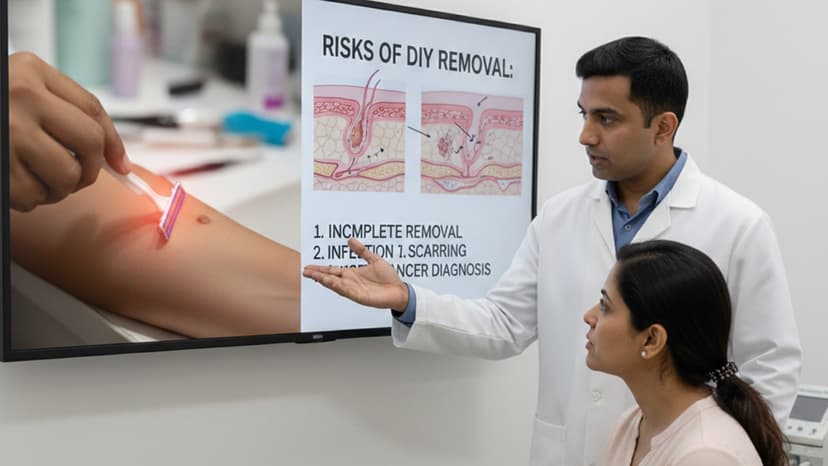
Engaging in DIY procedures to remove skin growths at home carries significant dangers, as highlighted by medical professionals. Dr. Mahyar Maddahali cautions against self-treating, emphasizing that misidentifying a lesion is a primary concern. What appears to be a simple mole could be a sign of serious conditions, including various forms of skin cancer, or benign issues like psoriasis or cysts.
Another critical risk involves severe bleeding if a growth is connected to feeder blood vessels. Dr. Maddahali also points out the high probability of infection and that traumatizing a lesion can cause it to return, often distorted and more difficult to diagnose. Home removal complicates future medical assessments by destroying vital tissue, making it impossible for dermatologists to accurately determine depth, margins, or cellular behavior crucial for cancer detection.
Dr. Swetha Sridhar explains that harmless moles are typically symmetrical, evenly colored, and stable. Any change in size, shape, or color, as well as bleeding, itching, or pain, warrants professional evaluation. Warning signs include rapid growth, blurred borders, uneven colors, and the 'ugly duckling' sign. Safest removal involves a dermatologist's evaluation and sterile procedures like excision or shave removal, either for medical necessity or cosmetic reasons after confirming the lesion is benign.