feedzop-word-mark-logo
searchLogin
Feedzop
homeFor YouUnited StatesUnited States
You
bookmarksYour BookmarkshashtagYour Topics
Trending
Terms of UsePrivacy PolicyAboutJobsPartner With Us

© 2026 Advergame Technologies Pvt. Ltd. ("ATPL"). Gamezop ® & Quizzop ® are registered trademarks of ATPL.

Gamezop is a plug-and-play gaming platform that any app or website can integrate to bring casual gaming for its users. Gamezop also operates Quizzop, a quizzing platform, that digital products can add as a trivia section.

Over 5,000 products from more than 70 countries have integrated Gamezop and Quizzop. These include Amazon, Samsung Internet, Snap, Tata Play, AccuWeather, Paytm, Gulf News, and Branch.

Games and trivia increase user engagement significantly within all kinds of apps and websites, besides opening a new stream of advertising revenue. Gamezop and Quizzop take 30 minutes to integrate and can be used for free: both by the products integrating them and end users

Increase ad revenue and engagement on your app / website with games, quizzes, astrology, and cricket content. Visit: business.gamezop.com

Property Code: 5571

Home / Environment / Thwaites Glacier: A Ticking Time Bomb Beneath Antarctica?

Thwaites Glacier: A Ticking Time Bomb Beneath Antarctica?

1 Jan

•

Summary

  • Thwaites Glacier's potential collapse could raise global sea levels by 2 feet.
  • Warm ocean currents melt the glacier's floating ice shelf from below.
  • Scientists fear a self-reinforcing melt cycle could destabilize the glacier.
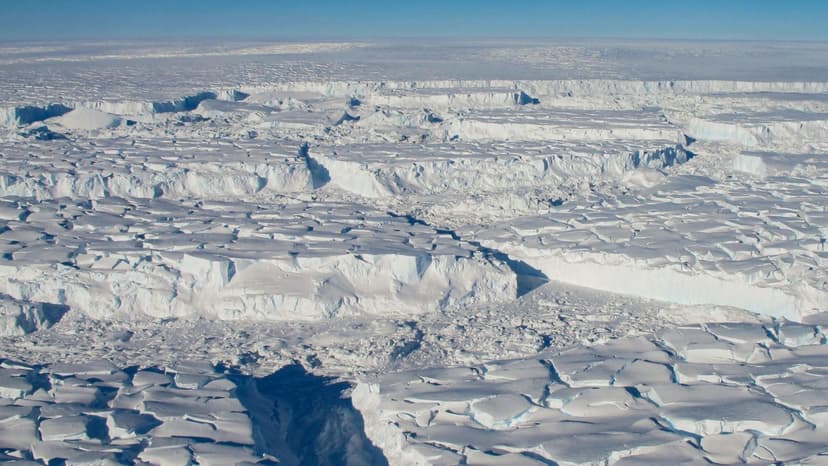
Thwaites Glacier: A Ticking Time Bomb Beneath Antarctica?

Scientists are closely monitoring the Thwaites Glacier in Antarctica, often called the "Doomsday Glacier," due to concerns about its potential collapse. This massive ice formation, roughly the size of Florida, could contribute two feet to global sea levels if it melts entirely. Current research focuses on understanding the rate of melting caused by warm ocean currents eroding the glacier's floating ice shelf from below.

Researchers are particularly worried about a feedback loop where the glacier's grounding line retreats inland on a downward-sloping bedrock. This retreat allows more warm seawater to access the glacier's base, accelerating melting and further retreat. This cycle could lead to irreversible destabilization, causing vast amounts of ice to flow into the ocean.

While some recent studies suggest certain catastrophic collapse scenarios are less likely, the overall threat remains significant. Scientists emphasize that reducing carbon emissions is crucial to mitigating the worst outcomes. The ongoing, incremental melting of Thwaites and other Antarctic ice poses an urgent threat to low-lying nations and ecosystems over the coming decades.

trending

S&P 500 sinks: Trump tariffs

trending

Russia's Kamchatka buried in snow

trending

Snowstorm forecast for UK

trending

Dormant Bitcoin whale moves $85M

trending

Detroit schools announce closings

trending

IBRX stock jumps 20%

trending

Covid investment scam resurfaces

trending

Micron stock soars with AI

trending

Bank Nifty declines further

Disclaimer: This story has been auto-aggregated and auto-summarised by a computer program. This story has not been edited or created by the Feedzop team.
The "Doomsday Glacier" is the nickname given to the Thwaites Glacier in Antarctica due to concerns about its potential collapse and impact on global sea levels.
If the Thwaites Glacier melts completely, it could add two feet to global sea-level rise, threatening coastal communities worldwide.
Warm ocean currents are melting the floating ice shelf of the Thwaites Glacier from underneath, and scientists fear a feedback loop could accelerate this process.

Read more news on

Environmentside-arrowAntarcticaside-arrow

You may also like

Antarctic Ice Shelves Melting Fast From Below

18 Jan • 34 reads

article image

Antarctica's Icy Vault: Ancient Climate Secrets Saved

14 Jan • 37 reads

article image

Antarctic Ice Sheet's Violent Past Revealed

12 Jan • 45 reads

article image

Antarctic Expedition Tackles World's Fastest-Melting Glacier

8 Jan • 112 reads

article image

Arctic Meltdown: Record Heat, Vanishing Ice

29 Dec, 2025 • 166 reads

article image