

Home / Environment / Solar Trees: Forests Meet Power Generation
Solar Trees: Forests Meet Power Generation
16 Apr
Summary
- Solar trees integrate vertical arrays within forest canopies.
- This design preserves 99% of tree canopy biomass and forest floor.
- Projects yield equivalent generation capacity to conventional farms.
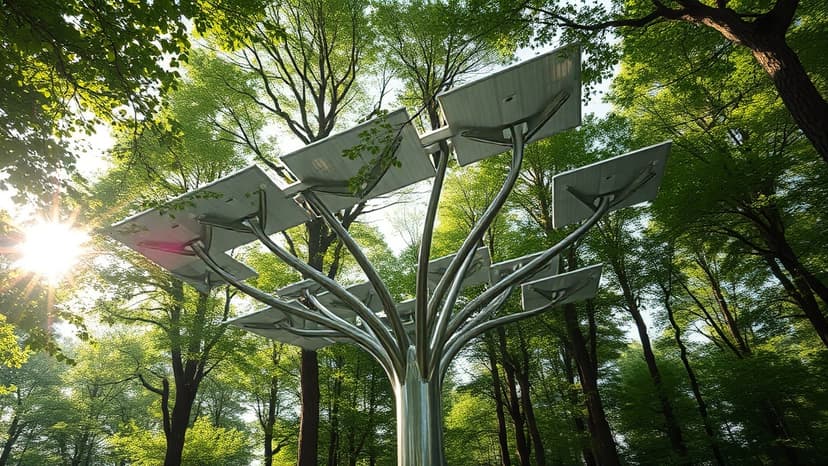
South Korea is spearheading a novel renewable energy approach with 'solar trees' that resolves the conflict between land use and environmental protection. Traditional solar farms often lead to extensive deforestation, but this new design features tall poles with photovoltaic panels arranged vertically within forest canopies. This integration allows for projects that maintain 99% tree canopy cover and achieve generation capacities equivalent to conventional solar farms.
The primary challenge for large-scale solar projects in mountainous regions is the need for flat land, often necessitating tree removal that hinders carbon sequestration. Solar trees, by design, leave the forest floor and understory largely undisturbed. Researchers utilized 3D geospatial data and simulations to optimize the height and placement of these solar trees, ensuring they can clear the surrounding canopy and maximize energy production.
This specialized application of agrivoltaics, promoted by organizations like the IEA and DOE, highlights the importance of utilizing vertical space, especially for nations committed to net-zero emissions by 2050. By preventing deforestation, areas with solar trees continue to act as vital carbon sinks, absorbing carbon dioxide while generating clean electricity, resulting in a net-positive environmental impact.
