Home / Environment / Desert Transformed: City Rises Around Man-Made Lake
Desert Transformed: City Rises Around Man-Made Lake
22 Aug
Summary
- A planned city was built around a man-made lake in the Mojave Desert.
- London Bridge was dismantled and rebuilt in Lake Havasu City.
- NASA's Landsat mission documented the desert landscape's transformation.
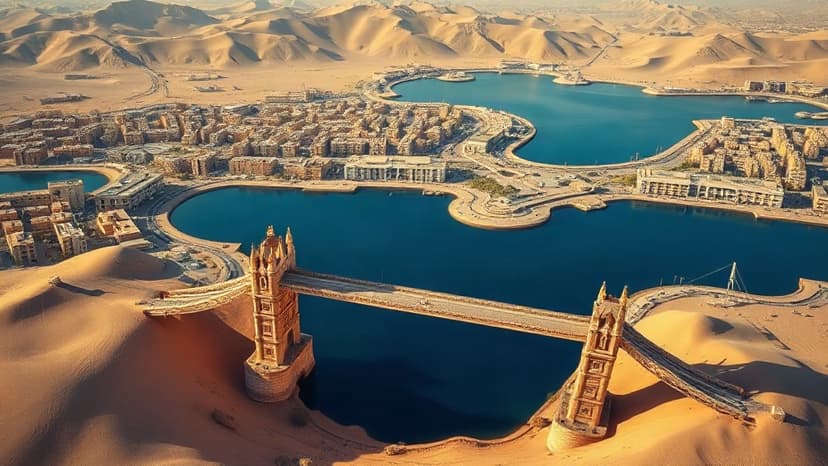
Once a desolate stretch of the Mojave Desert, the area around the California-Arizona border has undergone a remarkable transformation into Lake Havasu City. This planned community was meticulously constructed around a newly formed man-made lake. The genesis of this development traces back to the 1930s with the construction of the Parker Dam on the Colorado River, which created Lake Havasu and facilitated water diversion for Southern California.
Decades after the reservoir's creation, the land remained largely undeveloped until businessman Robert P. McCulloch envisioned a city. His ambitious plans included purchasing federal land and famously acquiring London Bridge, which was dismantled and reconstructed in Lake Havasu City between 1968 and 1971. This iconic landmark, combined with a distinctive street network designed by Disneyland's planner, established the city as a unique tourist destination.
NASA's Landsat data, utilizing historical maps and satellite imagery, vividly illustrates the rapid changes. What began as a sparse landscape with a single road in 1911 evolved into a developed area with extensive infrastructure by 1970, and a burgeoning city by 1994. By 2010, Lake Havasu City was home to over 52,527 residents, attracting a significant seasonal influx of 'snowbirds.'
Despite extreme summer temperatures reaching up to 50°C and minimal rainfall, the city thrives due to its lake, offering abundant watersports. However, the large reservoir's impact on water chemistry, downstream flooding, and aquatic life, as well as the effects of urban growth on groundwater and the ecosystem, remain subjects of ongoing scientific inquiry.


