

Home / Environment / Michigan Revamps Air Alerts After Wildfire Smoke
Michigan Revamps Air Alerts After Wildfire Smoke
15 Apr
Summary
- Michigan will now alert residents for orange AQI levels.
- Wildfire smoke caused poor air quality in Detroit in 2023 and 2025.
- New alerts begin this summer due to updated communication.
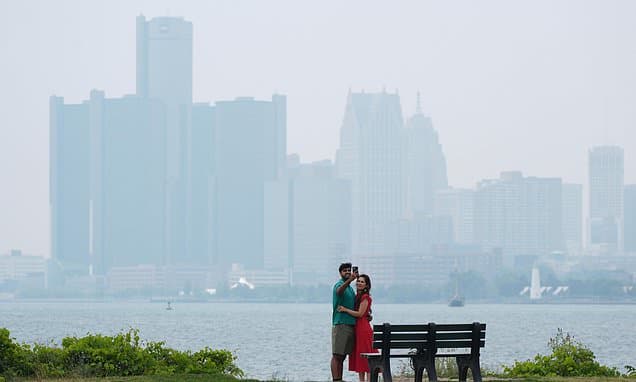
Michigan is enhancing its air quality alert system in response to severe smoke impacts from Canadian wildfires in recent summers. The state will now issue public alerts whenever fine particulate matter or ozone levels reach the "unhealthy for sensitive groups" or orange range on the federal Air Quality Index.
Previously, alerts were only issued for the "unhealthy" or red AQI range, with advisories for orange levels. This change reflects an evolution in the state's communication strategy, acknowledging the significant health risks posed by wildfire smoke, which contains fine particulate matter (PM2.5) that can lodge in lung cells and enter the bloodstream.
Forecasting wildfire smoke impacts beyond 24 to 48 hours remains challenging due to the unpredictability of long-distance smoke transport. Residents are advised to use resources like the EPA's AirNow webpage and EnviroFlash system for forecasts and local alerts. Private networks like JustAir and PurpleAir offer more localized monitoring, while FireSmoke Canada provides a ground-level smoke forecast map.
While forecasts suggest fewer fires north of the border this year, the potential emergence of an El Niño pattern could increase fire risk in western Canada later in the summer. Meanwhile, the western United States is predicted to have a severe fire season, exacerbated by widespread drought conditions and below-average precipitation. Climate change continues to be a significant factor increasing wildfire risk across the U.S.
Health officials emphasize that children, pregnant individuals, and older adults are particularly vulnerable to air pollution. Exposure to high levels of outdoor air pollution is linked to increased emergency department visits, hospitalizations, and even deaths. To mitigate exposure, Michigan's Department of Health and Human Services recommends using air purifiers with MERV-13 filters or higher, running air conditioning with fresh air intakes closed, and using N95 or P100 respirators when outdoors in heavy pollution.
