Home / Environment / Kansas Tremors: Ancient Volcanoes Rumble Again
Kansas Tremors: Ancient Volcanoes Rumble Again
26 Feb
Summary
- A 3.5-magnitude earthquake occurred near Assaria, Kansas.
- The tremor was linked to ancient volcanic rock and fault lines.
- Locals reported the earthquake sounded like loud thunder.
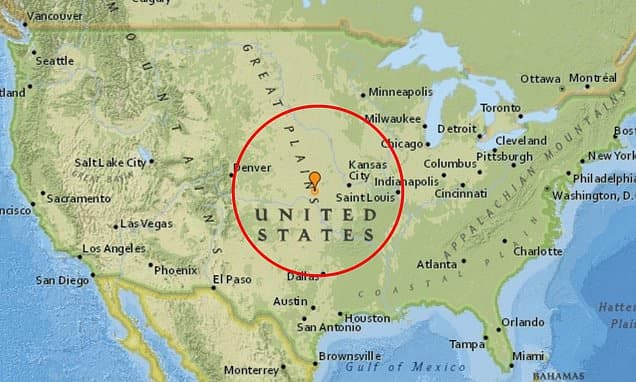
A 3.5-magnitude earthquake struck near Assaria, Kansas, on Wednesday afternoon. The tremor was detected at 3:14 PM ET and was felt by locals who described it as sounding like a "huge clap of thunder."
The earthquake's location is significant due to underlying ancient volcanic rock and the Humboldt Fault Zone. This fault zone, formed hundreds of millions of years ago, remains capable of producing moderate earthquakes when stress accumulates along its buried fractures.
Scientists explain that the North American plate is under constant stress, which concentrates along pre-existing weaknesses in the crust. When sufficient strain builds, the rock can slip, releasing seismic waves. The structural weaknesses created by ancient volcanic activity over a billion years ago, combined with the Humboldt Fault Zone, play a role in where and how earthquakes occur beneath Kansas.
The Humboldt Fault Zone is capable of producing moderate to potentially damaging earthquakes, with the largest known historical event estimated between magnitudes 5.0 and 5.5 in 1867. While generally less active than other seismic zones, it is connected to the Nemaha Ridge and could potentially generate earthquakes up to magnitude 6.5 to 6.7.