Home / Environment / Tiny Beetle Threatens Italian Wine Harvest
Tiny Beetle Threatens Italian Wine Harvest
20 Jul
Summary
- Iridescent green beetles from Japan are devastating Italian orchards and vineyards.
- The invasive Popillia japonica, first detected in Europe in 2014, spreads rapidly.
- Controlling the pest involves attacking larvae, using traps, and applying pesticides.
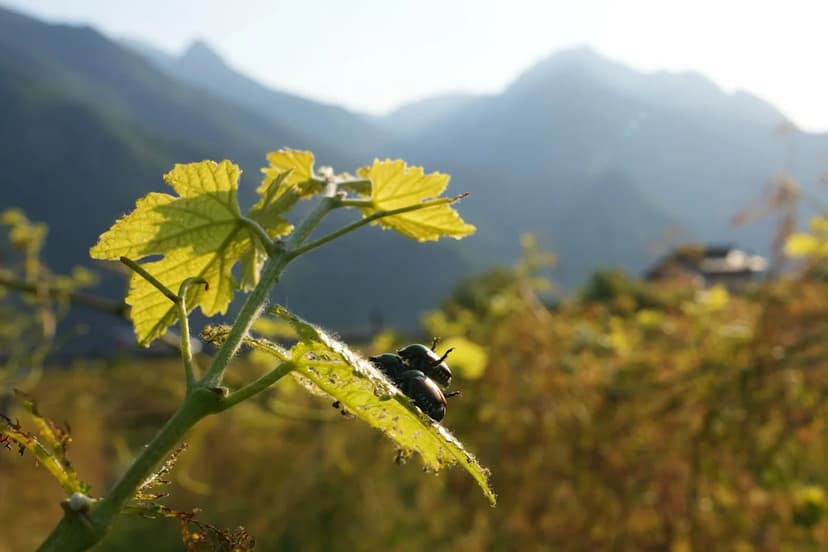
A menacing iridescent green beetle, the Popillia japonica native to Japan, has become a significant pest in Italy's agricultural landscape. This invasive species, first identified near Milan's Malpensa airport in 2014, is now prevalent in the northeastern regions of Lombardy, Piedmont, and Valle d'Aosta. The beetles consume the pulp of leaves, weakening plants and reducing crop yields without necessarily killing them, creating devastating lattice patterns.
With no natural predators and an appetite for over 300 types of plants, the Japanese beetle is a priority pest for the European Union, requiring containment and eradication efforts. It has already established itself in Italy, Switzerland, and Germany, with populations in France and Spain still offering hope for eradication. The beetle's voracious feeding habits and ability to spread via transportation pose a substantial threat, particularly to the Po River Valley, Italy's breadbasket.
Viticulturists like Luciano Zoppo Ronzero are witnessing the beetle's steady progression up mountainsides, impacting historic vineyards. The defoliation exposes grape clusters to the sun and impairs photosynthesis, jeopardizing the ripening process and the quality of the harvest. Beyond vineyards, the beetle's larvae, known as grubs, damage lawns and playing fields by feeding on grass roots.
Strategies to combat the pest are underway, focusing on attacking the larvae. Experts are experimenting with introducing microscopic parasites near airports where beetles have been detected. Pheromone traps are widely used, while wine producers in Donnas employ pesticide treatments, despite their short-lived effectiveness on steep terrain. Without intervention, the beetle population is expected to rise, leading to further damage to fruit plants, grasses, and ornamental flora, though they pose no direct danger to humans.


