Home / Environment / Helicopter Drops Tiny Forests to Fight Invasive Grass
Helicopter Drops Tiny Forests to Fight Invasive Grass
4 Aug
Summary
- Helicopters air-dropped 90 pallets with native trees and shrubs.
- The pallets targeted invasive reed canarygrass choking wetlands.
- This novel method aims to restore native plants in hard-to-reach areas.
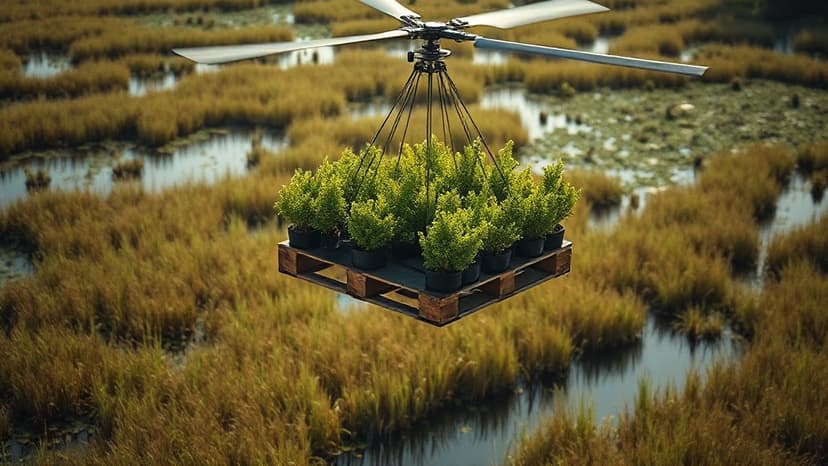
In 2023, a unique wetland restoration project took place in Washington state, where helicopters were employed to deliver pre-planted vegetation. The Tulalip Tribes utilized this innovative method to address the pervasive issue of reed canarygrass, an invasive species detrimental to native wetland ecosystems.
The invasive reed canarygrass forms dense mats, suppressing native plants, reducing biodiversity, and degrading crucial habitats for fish and birds. Traditional manual removal methods are often impossible in dangerously wet or inaccessible terrains, which prompted the development of this aerial strategy.
Ninety wooden pallets, each carrying one native tree and four native shrubs, were planted and then airlifted by helicopter into targeted restoration plots. This approach introduced approximately 450 young plants to the affected wetland area. For comparative analysis, the project also involved planting willow live-stakes and leaving some plots as controls.
This initiative, funded by the U.S. Environmental Protection Agency, is being monitored for at least five years to assess its effectiveness against the older stake-planting method. If successful, the floating pallet strategy could be adapted for restoring other challenging wetland environments nationwide.


