Home / Environment / Coastal Lions' Diet Surprise: Wild Prey Dominates
Coastal Lions' Diet Surprise: Wild Prey Dominates
18 Jul
Summary
- Wild prey constitutes 64% of Asiatic lions' diet in coastal Gujarat.
- Nilgai forms the largest part of the lions' wild prey consumption.
- Healthy wild prey populations reduce pressure on livestock in coastal areas.
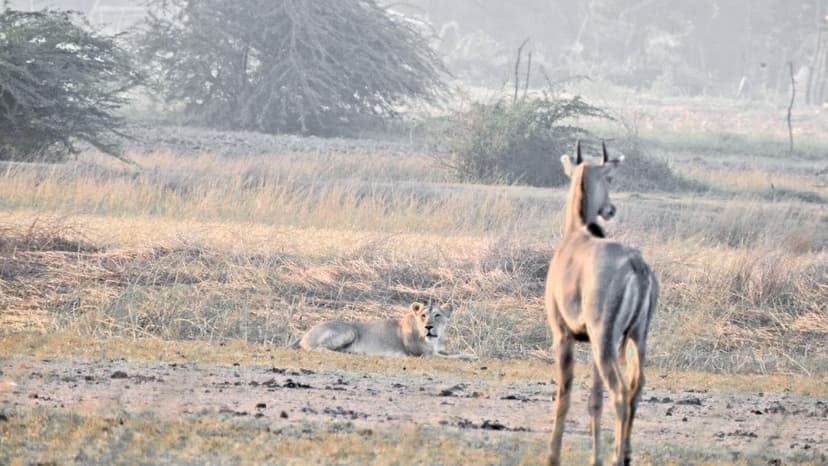
Asiatic lions inhabiting Gujarat's coastal regions predominantly prey on wild animals rather than livestock, a recent study published in Conservation indicates. Analysis of 160 lion scat samples collected in March and April 2024 revealed that wild prey accounted for 64% of the lions' diet and 70% of the biomass consumed. Nilgai, or blue bull, was the most significant prey species, contributing 51% of the biomass, followed by wild pigs.
The findings challenge the hypothesis that lions in human-dominated landscapes would heavily depend on domestic animals due to limited wild prey. The study concludes that robust populations of nilgai and wild pigs along the coastline allow lions to sustain themselves on natural prey. This shift reduces pressure on livestock and offers a successful conservation model for large carnivores expanding into multi-use areas.
Gujarat's coastal ecosystem supports over 100 Asiatic lions across three satellite populations. The consumption of cattle is believed to include many feral or non-productive animals. Conserving wild prey is deemed crucial for the long-term survival of lions outside protected forests. The State Forest and Environment Minister noted that these lions also benefit farmers by controlling nilgai and wild pigs that damage crops.


