Home / Business and Economy / India-Saudi Ties: Beyond Oil, New Economic Pillars Emerge
India-Saudi Ties: Beyond Oil, New Economic Pillars Emerge
3 Oct
Summary
- Economic ties expand beyond oil to infrastructure, tech, and healthcare.
- Saudi investment in India reaches $10 billion; Indian investment is $3 billion.
- Bilateral trade reached $41.07 billion in FY2025-26, showing diversification.
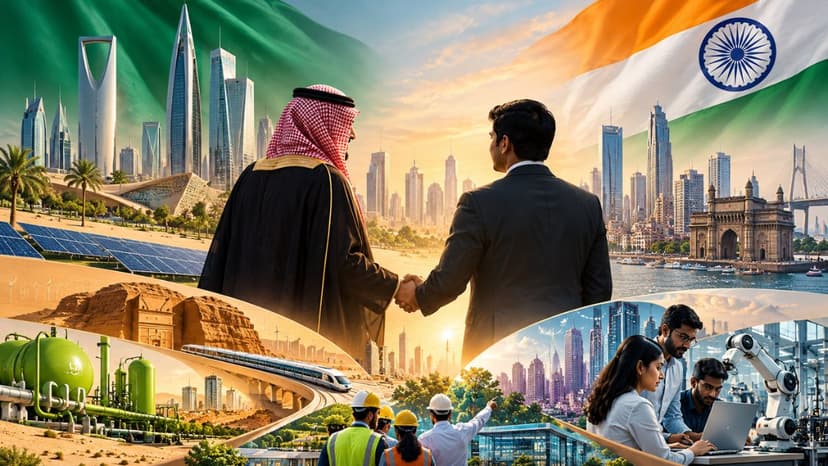
The economic relationship between India and Saudi Arabia is undergoing a significant transformation, moving beyond its historical reliance on oil. Both nations are actively fostering growth in diverse sectors, including infrastructure, manufacturing, technology, and healthcare, reflecting Saudi Arabia's Vision 2030 program.
This diversification is evidenced by substantial investments. Saudi Arabia, including its Public Investment Fund (PIF), has invested approximately $10 billion in India across various sectors. Conversely, Indian companies have invested around $3 billion in the Kingdom, with over 6,000 Indian firms registered there.
A Bilateral Investment Promotion and Protection Agreement was approved, aimed at facilitating smoother capital flows and balancing investor protection with regulatory rights. This treaty provides a more streamlined arbitration process for investors.
Saudi Arabia is increasingly opening its economy to foreign capital through reforms like allowing foreign investors direct access to its stock exchange and easing real estate ownership rules for non-Saudis. Its National Privatization Strategy targets substantial private investment by 2030, creating opportunities for Indian businesses in areas like healthcare and education.
The Public Investment Fund (PIF) is central to this economic shift, focusing on domestic sectors such as tourism, urban development, advanced manufacturing, and clean energy. Mining is also emerging as a key growth area, with plans to significantly increase investment and foreign direct investment.
While oil and gas remain important, accounting for a substantial portion of bilateral trade, the trade composition is diversifying. India's exports now include more than just traditional goods, and Saudi Arabia's imports show a growing demand for machinery, technology, and infrastructure.
Cooperation extends beyond economics into defence, technology, and cultural exchanges, formalized through a Strategic Partnership Council. The substantial Indian diaspora in Saudi Arabia and pilgrimage activities also continue to strengthen people-to-people ties.
Despite the push for diversification, energy remains a critical component, particularly given recent shipping route disruptions. The overarching goal is to build a relationship supported by multiple economic pillars, rather than relying solely on oil.
Saudi Arabia's economic growth projections indicate a strong non-oil sector expansion, attracting significant foreign direct investment. This presents India with opportunities in investment, exports, manufacturing, technology, and infrastructure development, fostering a multifaceted and robust partnership.


