feedzop-word-mark-logo
searchLogin
Feedzop
homeFor YouUnited StatesUnited States
You
bookmarksYour BookmarkshashtagYour Topics
Trending
Terms of UsePrivacy PolicyAboutJobsPartner With Us

© 2026 Advergame Technologies Pvt. Ltd. ("ATPL"). Gamezop ® & Quizzop ® are registered trademarks of ATPL.

Gamezop is a plug-and-play gaming platform that any app or website can integrate to bring casual gaming for its users. Gamezop also operates Quizzop, a quizzing platform, that digital products can add as a trivia section.

Over 5,000 products from more than 70 countries have integrated Gamezop and Quizzop. These include Amazon, Samsung Internet, Snap, Tata Play, AccuWeather, Paytm, Gulf News, and Branch.

Games and trivia increase user engagement significantly within all kinds of apps and websites, besides opening a new stream of advertising revenue. Gamezop and Quizzop take 30 minutes to integrate and can be used for free: both by the products integrating them and end users

Increase ad revenue and engagement on your app / website with games, quizzes, astrology, and cricket content. Visit: business.gamezop.com

Property Code: 5571

Home / Business and Economy / India Joins US Race to Curb China's Mineral Grip

India Joins US Race to Curb China's Mineral Grip

8 Feb

•

Summary

  • US invites India to Pax Silica initiative to challenge China's critical mineral dominance.
  • Initiative aims to diversify supply chains for minerals vital to AI, EVs, and green energy.
  • India's rare-earth reserves are significant, but technology and capital remain hurdles.
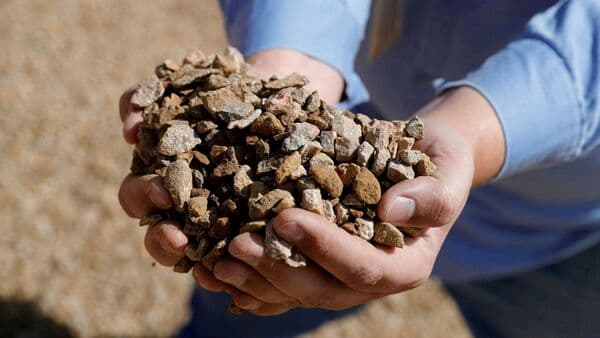
India Joins US Race to Curb China's Mineral Grip

The United States is actively seeking India's participation in the Pax Silica initiative, a global collaboration designed to disrupt China's control over critical mineral supply chains. Launched in December 2025 by the US, the initiative aims to foster international cooperation in mining, processing, and technology for essential minerals like lithium and rare-earth elements, which are vital for artificial intelligence, electric vehicles, and green energy technologies.

Currently, nine nations, including Australia, Japan, and South Korea, are official signatories, with several others as partners. China's significant market share, controlling around 90% of global rare-earth processing and a substantial portion of lithium-ion battery production, has prompted this diversification effort. Recent Chinese export restrictions on rare-earth magnets have underscored the vulnerability of global supply chains to single-country dependence.

trending

Justice Dept. Epstein files access

trending

ACC drops German gigafactory

trending

House of the Dragon vs Thrones

trending

Ola Uber Rapido strike

trending

Afghanistan spin threatens New Zealand

trending

Inter Miami plays Barcelona SC

trending

Warriors vs Lakers live stream

trending

Fiorentina vs Torino: Line-ups

trending

Real Sociedad vs Elche preview

While India holds substantial rare-earth reserves, its capacity for mining and refining has been limited by technological and financial constraints. The Indian government launched the National Critical Minerals Mission (NCMM) with a ₹34,300 crore budget to bolster its position in the supply chain. Short-term competition for China is unlikely, but collaborative models, potentially involving Quad nations, are being explored, with India serving as a manufacturing hub.

Future success hinges on international agreements for critical minerals. The US and its allies seek access to raw materials and manufacturing capabilities, while India requires technological and financial support. Experts suggest that rather than directly competing, Western nations should focus on innovation, recovery, and recycling to circumvent China's dominance.

Disclaimer: This story has been auto-aggregated and auto-summarised by a computer program. This story has not been edited or created by the Feedzop team.
The Pax Silica initiative is a global collaboration launched by the US in December 2025 to diversify critical mineral supply chains and challenge China's dominance in sectors like AI and electric vehicles.
China controls a significant portion of global rare-earth processing and lithium-ion battery production, leading to concerns about supply chain vulnerability and export restrictions.
India faces challenges in technological capabilities and capital expenditure needed for mining and processing critical minerals, despite holding significant rare-earth reserves.

Read more news on

Indiaside-arrowBusiness and Economyside-arrowAustraliaside-arrowSouth Koreaside-arrowChinaside-arrowArtificial Intelligence (AI)side-arrow

You may also like

Canada Sees India as Energy Necessity, Not Option

30 Jan • 83 reads

article image

Critical Minerals: The New Geopolitical Battleground

29 Jan • 77 reads

article image

China's EV Battery Tax Cut Sparks Indian Price Hikes

20 Jan • 141 reads

article image

Gigafactory Ignites Renewable Energy Revolution

19 Jan • 114 reads

article image

EV Battery Life: Myths vs. Reality

14 Jan • 147 reads

article image