Home / Arts and Entertainment / Goa's Ancient Konkani Inscription Found!
Goa's Ancient Konkani Inscription Found!
19 Jan
Summary
- First Konkani inscription discovered in Goa dates to 1583 CE.
- The sculpture was retrieved from a temple tank in Bicholim.
- Specific Konkani words like 'Goyem' appear in the ancient text.
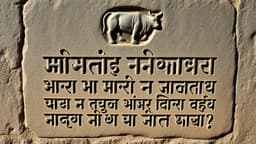
In a groundbreaking discovery for Konkani linguistic heritage, the first archaeological inscription in the Konkani language has been unearthed in Goa. The inscription, dating to 1583 CE, was found on a stone sculpture of Kalbhairav, retrieved from the Shree Chamundeshwari temple tank in Vargao, Bicholim, in 2010. This find is historically significant as prior archaeological evidence from the Konkani-speaking belt predominantly featured inscriptions in Kannada, Marathi, or Sanskrit.
Deciphered by the Archaeological Survey of India's epigraphy branch in Mysuru, the inscription's authenticity as Konkani is now confirmed. Professor Rohit Phalgaonkar, who supervised the sculpture's recovery and its subsequent display at a college museum, noted the inscription's unique use of words like 'Goyem' and 'Goyaantu'. These terms, commonly used today to refer to Goa, were previously absent in ancient Konkani references, which typically used 'Gopake', 'Gove', or 'Gopakapattanne'.
The inscription marks '1505 sake' (1583 CE) as the installation date, with a potential earlier date of 1579 CE noted for its commencement. The use of 'Goyem' and 'Goyaantu' twice in the text solidifies its Konkani origin, providing irrefutable evidence for the language's historical presence and evolution. A paper detailing this discovery has been presented and will be published by the Epigraphical Society of India.